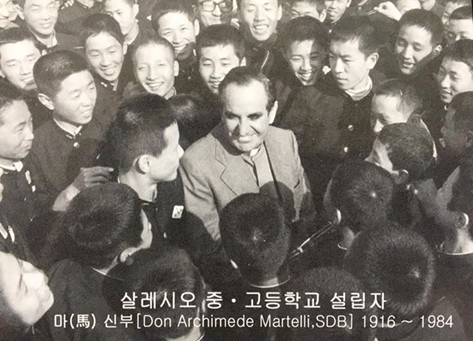
KOREA – Fr Archimedes Martelli (1916-1984)
Index
Chapter 1: Mantua, Lombardy – nostalgic place of origin
Chapter 2: Missionaries were forged in Ivrea
Chapter 3: Salesian venture in the Far East
Chapter 4: The Korean church asks for Salesians
Chapter 5: The first Salesian finally arrives in Korea
Chapter 6: Fr Martelli begins Salesian work in Gwangju
Chapter 7: Salesian work continues
Chapter 8: Opening of the Gwangju community
Chapter 9: The Dorim-dong parish in Seoul
Chapter 10: The school grows up
Chapter 11: A new development – the novitiate
Chapter 12: The first teacher returns, restarting with new heart
Chapter 13: The autumn of a life spent for the least
Chapter 14: Fr Martelli – a multifaceted personality beyond the normal
Chapter 15: Fr Martelli’s great achievements
Appendix 1: Bishop Mutel’s letter to (Blessed) Fr Michael Rua (1908)
Appendix 2: Personal testimony of Fr Jose Maria Blanco
Appendix 3: Personal testimony of one Salesian alumnus
Appendix 4: Nephew Franco Martelli remembers his Uncle
Chapter 1
A Nostalgic Homeland
Archimedes Martelli was born on November 23, 1916, in Comessaggio, northern Italy, an agricultural village in the province of Mantua (Mantova), in the central area of the prosperous Po Valley. He was the third of five children – four brothers and one sister.
His Mother, Ida Grazioli, a fervent Christian woman born in 1887, likewise saw that Archimedes had a fervent Christian upbringing. His father, Carlo, born in 1877, provided for the large family with great care. He was not a wealthy farmer, but he did have livestock. He was also a cattle dealer and ran the village butcher shop. Thanks to his father, Archimedes was able to spend a relatively happy childhood.
Archimedes two older brothers died at a relatively young age: Ugo died at 45, Aldo at 46 and Archimedes remembered them fondly. Only the younger brother, Giovanni, lived to old age – 89 to be precise.
Archimedes’ elder sister, Massimilla, played an active part in the Catholic movement and earned a great reputation. Fr Martelli said that his sister approached the convent to become a nun but her dream was not to be realized! She could not enter because of eye disease. A few months later she went on pilgrimage to Lourdes and prayed: “Lord, fix my eyes, or please rather let me die.” She returned home hoping to recover but within two months she died. That 1935, and she was only 28. The Mantua people still believe that she was close to being a saint and they have not forgotten her memory. This episode is regarded with pride in the family.
Archimedes so loved life that he always asked the Lord to let him live longer than his elder brothers. The Lord gave him a life of hard work and called him at the age of 68. He regularly prayed for his younger brother, and it seems the prayer for long life was transferred to Giovanni!
Mission at that time was a life commitment and absence from home, but with the arrival of easier travelling facilities, things changed. By December 1961 Archimedes was able to visit his family for the first time. Everything had changed back home. He visited his father’s, mother’s grave and graves of the two elder brothers whom he had so much admired. The only other member of their large family still alive was the younger brother Giovanni, who was now living in Milan with his wife Lina and son Franco.
But to return briefly to Archimede’s childhood: after completing fourth grade in primary school in his hometown, Archimedes went to Verona, the famed city of Romeo and Juliet. He studied in a Salesian boarding school till second year junior high, after which he applied to the Salesians in Turin and was sent to Ivrea as a missionary aspirant where he finished the aspirant courses before being sent to Japan.
Chapter 2
Missionaries were forged at Ivrea
Young people from Turin’s suburbs who first lived with Don Bosco a long journey ahead of them to become Don Bosco’s co-workers and leaders of other youth. Certainly, a boy like Michael Magone (a street-kid at the Oratory whose brief Life was written by Don Bosco) would have been capable of this, but he would still have had a long journey ahead of him too. After several disappointments, Don Bosco found the right formula to increase the number of his helpers. From the fervent Catholic families in the countryside where so many zealous priests dedicated themselves to the teaching of Christian Doctrine, young people like Dominic Savio came to the Oratory, and it was boys of such provenance who became the pillars of Don Bosco’s educational work.
With the increase in the number of Salesians, Don Bosco saw the possibility of bringing to fulfillment the regular missionary dreams that had filled his mind on many a night with new ideas and new projects.
With new missionaries leaving every year and new requests from the bishops in countries, especially in Latin America and Asia, Don Bosco began to set up a small Formation House in Piedmont and several other places in Italy.
The success of Don Bosco’s missionary venture, and his beatification and canonization aroused much enthusiasm among Catholic youth at the beginning of the twentieth century.
The adventures of Cardinal Cagliero and of many great missionaries, as told by the Salesian Bulletin and other missionary magazines, lit a flame in the hearts of many young people. This was the flame of bringing Christ’s love to the world and the desire to follow Christ to proclaim the Kingdom to all peoples.
The Salesians opened missionary institutes in many more places, to fan this flame and prepare young people in love with the missions. There they were trained and prepared to take the great leap forward.
Ivrea
Ivrea’s Cardinal Cagliero Missionary Institute was one of these institutions to become renowned for sending so many outstanding men to the missions all over the world. It is difficult to find accurate statistics of how many left Ivrea and died in faraway lands after a life given to spread the Good News. But even a “few hundred” would give us an idea of the vitality of this institution. To this we can add the places we know they went to as another way of understanding this prolific phenomenon: Patagonia, Japan, China, Siam (Thailand), India, Palestine, Ecuador, Mato Grosso, Rio Negro. All places where the people awaited the Good News
Ivrea is an attractive town on the banks of the Dora Baltea River in the Canavese area, and sits at the entrance to the Valle di Aosta. It is a place blessed for its natural beauty and economic vitality. Those were important factors to encourage young people who came from far away to engage in study.
The Ivrea Institute was the gift of the Venerable Lady Lidia Realis Richelmi, the mother of Ivrea’s Bishop Agostino Richelmi. It was a gift to the Salesians through the Rector Major, Fr Rua (the first successor of Don Bosco). The wonderful villa with its beautiful park became an agricultural school initially. After the First World War, the agricultural school transferred to a new location with more land. The Missionary Institute was founded in its place.
The place was suitable: sufficiently distant from Turin and the confusion of the big city, yet close enough so that the Major Superiors could often visit the future missionaries to help with their formation by talking to them about Don Bosco and missionary life.
The period of formation lasted four years, and commitment to studies was of great importance. However, by living their grand ideal in a fraternal atmosphere where the loving-kindness so much desired by Don Bosco reigned supreme, the youthful students were encouraged to continue joyfully along the way to the grand realization of their missionary dream.
We can read a small description of what Archimedes found during his time as a missionary aspirant in Ivrea. The name “Martelli Archimede” appears in the 1930 – 1931 school registers as being enrolled in third year high. He had already attended two years of junior high in Mantua. His progress in studies was rapid; he finished Year Four (school year 1931 – 1932) as second in the class and was accepted at the novitiate that he would have to make in Japan.
Leaving for the missions was no small step to take. Prior to the Second World War, when a missionary left, he left for life. After the Second World War, ocean liners plied the ocean routes and voyages were much facilitated. It was then established that missionaries could visit their homeland every 10 years. Nevertheless, a voyage to the Far East still took from three weeks to a month. With the advent of aircraft, all that has changed of course.
Family
The missionary aspirant was considered to be a young missionary who was encouraged to be in touch through correspondence. There was family contact up to the farewell visit before departure.
Holidays
There were but a few train stations for anyone going to the Valle di Aosta. From there they climbed on foot from Champorcher (main town in the Vall d’Aosta) to the highest village where the peasants emptied the stalls to lead the cows to high pastures where there was grass only during the two summer months. For the peasants it was considered a blessing to have the future missionary occupy the empty barns and stables and let them adapt the place to spend a month camping there.
The organizing group first had to wash the stables where the cows had spent the winter. It was necessary to channel the water from the stream into the stables and clean them up until one could actually see the wood-coloured floor. Then they would introduce military bunks and the “hotel” was ready! Barns and other rooms were found according to need.
Removed from the summer heat for a month, one could pray more easily than in Ivrea. There was time to review topics that had been less understood. There were language clubs, especially English, and times for sports. Then there was time for nature walks and excursions with the whole group to the famous Dondeina and Miseren sanctuaries. The bravest would have liked to climb the high peaks over 3500 metres, but the lack of suitable clothing, equipment, and qualified people ensured that these peaks were climbed only with the heart.
Chapter 3
Salesian venture in the Far East
With the death of Don Bosco, his successors continued to cultivate the missionary enthusiasm that en created around him. Requests for missionaries came from all over the world and decisions were made based on the real possibility of satisfying the various requests. Over the years, the Major Superiors realized that everything they did was already foreseen by Don Bosco’s dreams.
Vincent Cimattti – Don Bosco’s man in Japan
Don Bosco became so famous that in every place he went many people gathered to see him. Once Don Bosco went to Ferrara, a city in northern Italy: a mother among the crowd of people lifted her child saying: “Look at Don Bosco.” It would be the first thing that this young child would remember later in his long life. The name of this little boy was Vincenzo (Vincent) Cimatti. He kept on looking to Don Bosco throughout his life.
Still a young boy, Vincent applied to join Salesian life. He became a famous musician, and also gained a doctorate in biology. He was Superior of the famous school at Valsalice in Turin when the Superiors asked him to lead the group of young Salesians who were leaving Italy to start Don Bosco’s mission in Japan. He left his job in Italy and happily followed Don Bosco on such a great adventure.
Two letters on the desk
In 1923, the Salesian Superiors in Turin receive a very confidential communication from Rome. Japan was extending its influence and its dominion in Asia. It presented itself as one of the rulers of the future in this part of the world. For this reason the Pope decided to endure every sacrifice to extend Catholic missions in Japanese territory. The Salesians were invited by the Pope to settle in the provinces of Miyazaki and Oita: one and a half million inhabitants, three hundred Catholics served by three missionaries. The invitation from Rome says verbatim: “It is necessary that the missionaries be endowed with uncommon qualities, that they are able to direct high schools and institutes of education.”
That same year, Fr Cimatti wrote to the Salesian Superiors: “Find me a place in the poorest, most difficult, most abandoned mission. In relative comfort here, I do not yet find myself there. Give me a good answer!”
Fr Philip Rinaldi, Don Bosco’s third successor now leading the Salesian Congregation, found two letters on his desk: the one from Rome asking for missionaries, and the one from Fr Cimatti asking to be a missionary. He wondered if this was a coincidence organized by the Lord. He wrote to Rome asking for sixteen months to prepare the men to send.
The first group of nine Salesians led by Fr Cimatti sailed from Genoa on December 20, 1925 on the Fulda, a ship belonging to a German company. On the morning of February 8, 1926, the fog cleared in the port of Moji. The Salesians could see Japanese land for the first time. Here is the beginning of the great Salesian adventures in the Far East.
Archimedes Martelli would arrive in Japan six years later. He would make his novitiate in Japan and would be trained to become a priest and help keep the Congregation alive during and after the Second World War. He would eventually leave Japan to bring Don Bosco’s charism to Korean soil.
Martelli – a young Salesian in Japan.
Once the young student Archimedes had arrived in Japan and completed his early formation there, he attended the Salesian preparation courses in Miyazaki and completed the basic course with excellent grades. He majored in theology at the Theological Seminary in Tokyo and was ordained priest in 1942. In the same year the new priest Fr Martelli was admitted to the prestigious Tokyo University but he refused this good opportunity and asked to go to Miyazaki where he could help the poor with Fr Antonio Cavoli. He had been appointed headmaster at Miyazaki Junior High School for two years while also continuing his theological studies,
In 1944, Fr Martelli began full-time work with Fr Antonio Cavoli, printing and sending out the ‘Distant Echoes’ newsletter to Italian benefactors. The income was given to an orphanage and a nursing home run by the Caritas Sisters. This new Congregation was founded Mons. Cimatti and Fr Cavoli, involving volunteer girls that used come to help the elderly. After the attack on Pearl Harbor, everything became much more difficult but they continued their charitable activities to help the elderly and the poor with confidence in Providence.
Fr Cavoli had spent the last ten years in Miyazaki, Kyushu, living like a saint, devoting himself to orphans, the elderly, and poor patients who had no place to depend on. He was an Italian, born in the same village as Benito Mussolini, and had a strong will second to none. Because Fr Martelli lived under the guidance of such a wonderful priest, it became a major influence on his formation and future life direction.
Following this, Fr Martelli went to work with the Caritas Sisters in Myaguchi, helping them with building, farming, catering and publishing newspapers. He was happy to look after the nursing home and connect the Sisters with benefactors, but one day he was ordered by his Superiors to go to Manchuria to fulfil missionary work there.
Following his Provincial’s wish, on August 6 1944, he set out by ferry to Busan from Mogi harbor in Japan. Arriving in Korea, he crossed the Korean peninsula from Busan, through Seoul to Pyongyang and then through Manchuria by railroad to Dalian. Fr Martelli never dreamed that he ten years later he would be spending the rest of his life in the country he was crossing at that time.
At the time, Dalian had 400,000 Chinese, 200,000 Japanese and 7000 White Russians, nobles who had avoided the revolution. It was a flourishing, a city full of life. Fr Martelli learned Chinese from a Russian countess and English from the parish priest who later became bishop. At night, he practised his Chinese by teaching Chinese to a small group of British students. He spent three years in Dalian.
The Russian army occupied Dalian and terrorized the inhabitants. Soviet soldiers were of extremely low morality, rushed into the Sister’s Convents, took over properties and churches, and deported nuns and priests. At that time the parish priest barely escaped, using the secret corridor. From then on it had been difficult to do missionary work in Manchuria, so they had to return to Japan. In 1948, Fr Martelli came back to Japan and became an associate of Takasuya Tokyo Junior High School as Headmaster.
Chapter 4
The Korean Church asks for Salesians.
According to our sources, the first time the Salesians were asked to come to Korea was in 1908 (Twenty years after Don Bosco died, and two years after missionaries were sent to India and Macau). At that time the Bishop of Korea, Gustav Charles Marie Mütel, MEP (閔德孝 1854-1933) was trying to open a teacher training school to obtain qualified staff for Catholic schools.
Bishop Mütel went around Europe trying to enlist religious institutes engaged in education and missionary activity to help open up a teacher training school in Korea. At the time he met Fr De Bagneux, the Superior of the Salesian southern French Province. He gave him a brief report on the state of the Korean Church and asked that some Salesians be sent to help with the project.
But at that time the French Salesians were short of personnel and could not send anyone to Korea. However, he did send the brief report to Fr Rua, the Rector Major. Unfortunately there was no response from Fr Rua either. In spite of that Bishop Mütel’s hopes of having the Salesians were taken up by his successors.
After religious freedom was established, the Korean Catholic Church sensed the importance of education and establishing schools, even during the Japanese occupation which obstructed the establishment of schools through any number of restrictions. The Church made every effort to invite foreign missionaries and educational Religious Congregations to establish a school for human resource development and evangelization. In addition, the church was promoting doctrinal knowledge and faith among believers and youth in Seoul and the provinces through publishing activities, one of which was to introduce the lives of Catholic Saints.
After Bishop Mütel died in 1933, in 1935 his successor, Bishop Adrien Joseph Larribeau M.E.P. (元亨根 1883-1974) ordered the printing of the life of St John Bosco and an introduction to the Salesian society in the “KyeongHyang Japji” on the occasion of Don Bosco’s beatification. The life of Don Bosco that was printed in this church magazine gave great impetus to the image of the Salesians as friends of youth.
The whole life and spirituality of Don Bosco was introduced by the magazine over 48 episodes over two years from 1935 to 1936, so that the Salesian Societywas able to prepare the ground for its future in Korea. This is also a record which testifies to the truth of Fr Cimatti’s words. “Don Bosco has gone to Korea before the Salesians.”
In May 1936, Bishop Larribeau built a new parish church in Dorimdong, which was part of a newly developing industrial section of Seoul called Yeong Deung Po. On the feast of Don Bosco, January 1st 1937, he gave the church the title of St John Bosco. He then invited the Salesians to come and take up the pastoral work connected with this zone. But again the the Salesians were unable to respond. After the expulsion of all foreign missionaries by the Japanese, Bishop Larribeau’s successor, Bishop Paul Ki Nam Ro (盧基南 主教 1902-1984) also asked for the Salesians to come but his wishes were unable to receive a positive response at that time.
When the Second World War ended, Korea became an independent nation. But soon the Korean War began in 1950. Even during the war, again from 1951, Bishop Paul Ro repeatedly asked for Salesians through the Apostolic Delegate residing in Japan, Bishop Massimiliano Furstenberg. But the time for the Salesians to enter Korea still had not arrived.
Mons. Cimatti – Big hopes for Korea
There were difficulties in finding the right way to get involved in Japanese society. At the beginning of the apostolic work in Japan, the Salesians opened several educational works, but they faced many hardships in cultural adaptation and also very little interest by Japanese in any foreign religion. Those difficulties gave Mons. Cimatti a bright idea for filling the cultural gap: he was a musician, and Fr Margiaria, who was with him from the beginning in Japan, had a wonderful voice, so they started to give concerts. It was a huge success all over Japan. And they were invited to go to Manchuria where they gave concerts in the principal cities. When returning to Japan, they had an chance to visit Korea. Passing through Korea they visited Korean cities: Sinuiju, Pyongyang, Seoul and Daegu. Everywhere they received a huge welcome and were able to meet many Korean Catholics. Thus, Mons. Cimatti became the first Salesian who visited Korea unofficially according to the documents discovered so far.
From Mons. Cimatti’s diary
“25 26 September 1934 at Sinuiju on the way to Korea. On our return we accepted going through Korea as at least a nod to the desire of the bishops there, to make Salesian propaganda and learn many beautiful things that can serve for the apostolate. In the Maryknoll house we have seen a magnificent work for the youth: day and evening schools (things inconceivable in Japan) for catechetical instruction. There was a large assembly of Koreans and Japanese who, though few in number, were happy to say they were Catholic. It was precisely on the day of the feast of the Korean martyrs. Men and students were competing to enroll in the programs.
“27 September 1934, we were in Pyongyang with Bishop Morris, Maryknoll, who works with great enthusiasm and with good results. Even in Korea, the well-known cultural difficulties we find in Japan also apply. To one missionary who complained that he had no success, I advised him to look after the youth and do charitable activities.
“28 September 1934: in Seoul, welcomed by Bishop Laribeau, a friend of the Salesians of Don Bosco whose life he has had translated in episodes in the diocesan bulletin. I visited the magnificent buildings (seminary, commercial school, charity work, etc). The concert was for the charitable works of the diocese, organized by young people who play a fine role in the Catholic movement. Full and very successful. …
“29 September 1934: in Daegu, incessant rain. The police banned the sale of tickets at the last minute, attended by a hundred people. However, a good distribution of the Catholic press was made, and therefore good work was not lacking.
Following this concert journey, Mons. Cimatti wrote a long report to the Superior in Italy explaining to them the possibilities of opening a Salesian School in the cities of North East China, called Manchuria at that time, and the even bigger possibility of beginning Don Bosco’s work in Korea.
Following this visitation, Mons. Cimatti continued to receive news from Korea which he translated and published in the Italian “Salesian Bulletin”. One especially interesting news was the blessing of the Parish Church at Dorim-dong dedicated to Don Bosco, in Yeongdeungpo, which at the time was a famous industrial district south of the Han River in Seoul. Another good news was the blessing of the first statue of Don Bosco in the same Parish Church of Dorim-dong on June 9, 1938.
In Mons. Cimatti’s contribution to the “Salesian Bulletin” in 1939 he introduced Catholicism in Korea thus: “I (Mons. Cimatti) have already been to Korea when I performed some concerts. As we passed through, we found that believers knew about Don Bosco, because Koreans had already published an article about Don Bosco in the Kyong Hyang magazine. So, Koreans know Don Bosco, because they use his name as a Christian name. Bishop La Libo of the Paris Foreign Missions Society said this when inviting us to Seoul. Don Bosco arrived before of us. …. We cannot go because our Japanese confreres are few but if the Superiors allow us, we will go to Korea. Bishop La Libo sent a picture of Yeongdeungpo Church in a poor area where we would like to work …”
Mons. Cimatti finished his long report with the following exclamation: “But when will the Salesians be established in Korea?!”
It took 16 years, two wars of unbelievable cruelty, and the complete alteration of the map of the Far East before Mons. Cimatti’s wishes could be accomplished. At that time, Mons. Cimatti was no longer superior, and indeed was consumed by the difficult work and the many hardships he had faced, especially during the Second World War.
Chapter 5
Finally, the first Salesian arrives in Korea
In 1908, the Korean Church knocked on the door of the Salesians through the invitation of the Bishop of Seoul, Bishop Mütel, and the Bishop La Riva in 1937 or 1938. After this, in 1944, Bishop Noginam continued to invite them, but at that time, due to the circumstances of war with Japan and lack of Salesians it had not been possible to send a missionary to Korea. However, even amid the Korean War (1950-1953), the Seoul Bishop and the Kwangju Vicar Apostolic continued to ask the Salesians to come to Korea.
In 1953, the Diocesan bishop of Kwangju, Harold W. Henry S.S.C. (1909-1976) (Even though at that time he was Vicar Apostolic we will continue to call him a bishop; he led the diocese till it became an Archdiocese) in the southwest of South Korea, made a concrete proposal to the Salesians in Japan. As an American, he was well aware of the spirituality and educational activities of the Salesians since his seminary days, and he personally respected Mons. Cimatti. When he became Vicar Apostolic in Kwangju, he did not delay and sent a letter to the Salesian Superiors in Turin and to Propaganda Fide at the Vatican, as well as to the Salesian Superiors in Japan, inviting the Salesians to his Diocese in Gwangju.
At the time, Bishop Henry had received an offer of US $100,000 from a foundation established to set up a school in memory of an American chaplain, Fr Emil Joseph Kapaun (1916-1951) who was killed during the Korean War. He promised to give this offer to the Salesians. He asked the Salesian Superior in Japan to send confreres and build a school. In 1953, with the danger of war in Korea still not over, Bishop Henry urged the Superiors in Turin to send Salesians to his Diocese. The provincial of Japan, Fr Clodoveo Tassinari. (1912- ) visited the diocese of Kwangju to explore the situation.
He returned to Japan saying: “I visited Korea and have interpreted the keen desire of the Korean church so favourable toward the Salesian Society, the optimistic attitude of Bishop Harold, the benevolent opening to the spirit of Don Bosco so widespread in the Korean church, and I believe we should go there, but I cannot make a decision right away. So, after pondering on it, we will take the decision.”
The Salesians in Japan decided to send confreres to Kwangju. Many Salesians, including Mons. Cimatti himself, wanted to come to Korea. Finally, on August 12, 1954, Fr Archimedes Martelli (1916-1984) was sent as the first Salesian missionary to enter Korea on a permanent basis. It was 45 years after Bishop Mütel had first invited the Salesians to Korea (1908).
At the time, Korea had just finished a three-year war (1950-1953). Korea was devastated, poor and wretched. There were a lot of orphans and it was a period in which the financial, political and social aspects of Korean society were in great hardship and confusion. Upon arriving in Korea Fr. Martelli wrote the following:
“Everywhere you can see the despoliation of war and so many poor people. There is no order in society. There are many beggars and especially many young people on the street. They don’t even have the basic necessities of life. It is like it was in Japan after the Second World War … I have discovered one very surprising thing. There is a large church named after St John Bosco. It can accomodate over 1000 people. I have also met many of the faithful whose baptismal name is Bosco. A lot of people know about Don Bosco. There is even an orphanage named ‘John Bosco House’ and in the parish there is a group of faithful called ‘The Don Bosco Society.’ “
Fr. Martelli, just like Fr. Cimatti, was able to sensel that Don Bosco preceded the Salesians in Korea. At the time and under those circumstances, one can imagine how difficult it was to build a school. The Bishop of the Diocese of Kwangju (Bishop Harold W. Henry S.S.C.) and the Salesian Provincial of Japan, Fr Clodovico Tassinari (1912- ) were the two key persons who succeeded in making the decision to erect the school in Kwangju after many letters and meetings; a long negotiation!
Before continuing the narrative, I believe it would be good to give some space to Fr Emil Joseph Kapaun (1916-1951) since it was his death that made it possible for the Salesians to come to work for the education of youth, as we have already mentioned.
Gratitude to Fr Emil Joseph Kapaun
Fr. Kapaun was born on April 20, 1916. After attending the parish school and high school, on September 11, 1936 he entered Kenric Seminary in St. Louis, Missouri. Following his theological studies, he was ordained a priest on June 9, 1940, at St John’s Cathedral in Wichita. After his priestly ordination, he was appointed as the assistant priest of his hometown. From January 1943 until June 12, 1944, he began to serve as assistant chaplain at the Herrington Army Airfield, Kansas, and enjoyed the work in the army.
On September 16, 1943 he was appointed pastor of St. John’s Cathedral, after Fr. Screener retired due to age. Fr Kapaun always made people interested in the Church and organized a youth group with special attention to the children. Even during busy periods he enjoyed playing baseball with the kids. He helped everyone without distinction, from any denomination, and was always willing to help. With this kindness he became a hero. However, he decided to minister to young souls on the battlefield. In 1944 he graduated from the Chaplaincy School. In 1945 he was sent overseas and worked in northern India. In 1948, he received a master’s degree in education from the American Catholic University.
Fr Kapaun became a chaplain once more and was assigned to a unit dispatched to Japan, and, following this unit, fought in the Korean War which began on July 11, 1950. During the war he received the Venus Medal from the US government. On November 2, 1950, he was taken prisoner by the Chinese Army. For nearly six months, while he was groaning under all kinds of torture and abuse from the Chinese Army, he did his best to continue his pastoral work for the soldiers. He lived faithfully as a servant of the Lord and was happy to be given the nickname “Christ with the crown of thorns.” His fascinating life came to an end on May 23, 1951, at Pyoktong Chinese prison camp. In 1953, at a memorial mass in Wichita St. Mary’s Cathedral, Kansas, USA, his lifetime achievements became widely known to all.
His sublime death did not end with death, but was passed on throughout the United States through the returnees who survived as prisoners in prison camps with him. Many of them had realized his amazing love and sacrifice. They took an active part in promoting projects to honour him, and to celebrate his great life, and ensure posterity knew about it.
The survivors knew of his plans to remain in Korea and rebuild education there, so after the war, through a foundation established in his name, they began to finance projects to fulfill his wishes. The large offer of US $100,000 from the foundation which came to Bishop Harold W. Henry was the foundation stone that allowed him to buy the land and start the construction of the school. When the school building was completed and the historic ceremony was held on March 19, 1956: Bishop Herald said:
… “Really, we must thank God that we can build a great school at this difficult time. This school is to be called the Fr Kapaun Commemorative Technical School.”
In the end, the Salesians were able to go to Korea because of the continuous invitation from the Korean Church, the active preparation of the confreres in Japan under the zealous guidance of Mons. Cimatti, the strong desire of Bishop Harold. We can consider the love and sacrifice of a great military chaplain and priest, Fr Emil Joseph Kapaun (1916-1951) to be the main factor which opened the door of Korea to the Salesian Congregation. We will never forget him!
Chapter 6
Father Martelli begins the Salesian work in Gwangju
The first member of the Salesian Congregation to live permanently in Korea, Fr Archimedes Martelli, arrived on August 12, 1954. The Provincial in Japan, Fr Tassinari, travelled with him. After arriving in Korea, they lived at the headquarters of the Columban Missionary Society in Kwangju and started the preparation works for building a school. Before the arrival of Fr Tassinari and Fr Martelli in Kwangju, Bishop Harold had already bought the school site with the donation from the United States, with the intention of building a technical school. The lengthy negotiations concluded with the meeting between the Bishop and Fr Tassinari.
Fr Martelli settled in Buk-dong, the Columban Parish. He prepared himself to remain in Korea by studying Korean. Without delay he also began work on building the school on September 9. The design for the technical school was a replica of Japan’s Osaka Salesian High School, built in reinforced concrete (anti-seismic). The provincial Fr Tassinari assisted Fr Martelli in the preparation works, and was able yo learn much about life in Korea. We can read the letter he sent to the confreres in Japan from Korea.
“In the middle of August, I went to Kwangju with Fr Martelli who was the former director of the Tokyo – Kokubunji (Kodaira) orphanage. He will be the person in charge of preparing the future school in Kwangju. There is already a large plot of land and the architectural plans are ready. Many others things need to be prepared for the future. First, we need to look for a company that can work with steel-reinforced concrete. Currently we cannot find everything in the Korean market: steel rods, cement, doors, and windows have not been found. Bishop Haroldd is now in the United States. He asked us to start building quickly. The Kwangju government is waiting for us to begin construction.
“Local citizens are also expecting a school to be built. (There are two universities in Kwangju.) Kwangju is the second most educated city in Korea, but due to the lack of schools, many young people in Jeolla Nam-do province are unable to receive the education they desired. We can no longer wait to be in touch with the building company run by some Catholics. The company have never built a reinforced concrete building, but they say they have the skills.
“Fr Martelli has begun looking for the necessary materials. Iron for doors and windows will be imported from Japan. He has to get special permission from the government. There are worries and anxieties about this, but we have started work, believing in Don Bosco…”
In those lines we can see the difficulties Fr Tassinari and Fr Martelli faced in this new setting; with courage they had to solve each problem one by one. It is also good to read a letter that Fr Martelli sent to the Provincial on 1 Sept. when he was alone after Fr Tassinari returned to Japan.
A difficult language
“…. It has been 20 days since I arrived here in Kwangju. I have been studying Korean hard since the evening of Father Provincial’s departure. It is more difficult than I thought. I study two hours a day with a teacher and study the rest myself. I have already studied Korean textbooks used in the first grade of primary school. I have begun the second grade textbook from today. The language is similar to Japanese, even in terms of expression, grammar and detail. That is why it is very advantageous for us. But easy words are completely different from Japanese, and the pronunciation is more difficult than Chinese. If Fr Liviabella was here, he would do better than me.
“The Fathers who live here do not speak Korean well. This is because they usually learn through conversation. By the way, these Fathers have earned a lot of respect, even with such poor Korean. Even though we speak the language well in Japan, we do not get respect. Here, with just a few words we can earn much respect. During the past two weeks I thought I might at least learn the language roughly. It needs a good memory to learn this language well. If you are over 30, your memory will be much weaker. This is what I experienced in Dalian. A few days ago I was afraid and ready to give up studying a new language because I doubted the possibility of this technical school due to so many difficulties. But I just gave myself courage and decided to go forward! …..
“…. I am getting used to customs in this place little by little. My room is convenient. I study Korean several hours a day and also learn English. On can learn English much faster than Korean. But there is no radio, no newspapers, no car and especially no Salesian confreres to speak with. This place is quiet and you do not have to worry about the world. A few days ago I went with a Columban to visit a US Military Unit. I saw the newspaper that day, and found out that the Italian Prime Minister, De Gasperi, is dead, and I also found out about a man named Varga who committed suicide …
We have a great apostolate ahead of us
“… Compared to Japan, Korea’s economic situation is way behind. But if you are a missionary in Korea you will immediately be impressed, and this is because of Korea’s zealous believers … we are really spreading the Good News among the poor as the Gospel asks us to do. We Salesians especially have a great apostolate ahead of us among the young people of Korea. Salesians in Korea can do the great things God has entrusted to them. The Salesians of Don Bosco, whom Don Bosco preceded in Korea, will do a wonderful job with Don Bosco’s help …
“… This place is next to Russia and China. And you can go to Italy by train! The situation here is a good opportunity for my spiritual life. I have plenty of time to meditate, I have time to think about my soul, and above all, I am helping my faith by seeing the example of fervent Koreans.”
The groundbreaking ceremony
Fr Martelli had been in Korea for less than a month. On September 9, 1954, the ceremony of turning the first sod for the school was held and construction began immediately. The school building was 75m long and 10m wide, and iron doors and window frames were imported from Japan. The school was built in red brick with the frame in reinforced concrete, The red bricks were made directly on the construction site.
Chapter 7
Salesian work continues
At the time, the Korean Church press began speaking about the Salesian School, which took just six months to complete. It also presented the individual Salesians who would run the school.
On April 30 1955, showed its interest in the school as follows: “Following the educational principles of Don Bosco, the Salesian Society, especially dedicated to the vocational education of youth, has entered the Korean Diocese of Gwangju through the efforts of Bishop Harold.”
It reported that the Salesian Society had sent a Salesian called Archimedes Martelli to Kwangju in August to buy 20,000 pyong of land [The pyong is a traditional Korean unit of area measurement equal to around 3,306 square metres], and on 9 September will begin construction of a school on 2,377 pyong.”
And on November 2 1955 the same paper reports:
“In June 1955 the Japanese Salesian Provincial sent Br. Yoo Chae-soo – John Baptist (유차수) (1923 ~?) to Kwangju. On November 21, 1955 he also sent Fr Kwon Young Kyun – Antonio, (권영균) 1920-1993). He then sent another priest from Argentina, Fr José M. Suárez SDB, 1926 ~) to help Fr Martelli in his difficult duties.” The article goes on to talk about the materials and equipment for the new building sent by the Salesians from Japan.
The Salesians from Japan were sent to help Fr Martelli prepare for the opening of the school, but for the Salesians to sink roots in Korea was not always an easy task. We come to know this from a letter Fr Tassinari wrote when he visited Korea in the middle of July 1955. He was thrilled to see the Salesians in the midst of so many problems, but the building going up without interruption.
Let us listen to Fr Tassinari.
“ Fr Martelli is accomplishing difficult things step by step. He has been given permission from the government to receive cement and steel rods for the reinforced concrete, to bring in doors made of iron from Japan. In addition, he has also received permission from the government to import other materials not available in Korea.
Fr Martelli immediately prepared the documents for a tax exemption for 40 tons of material coming from Japan When leaving Kwangju, friends told him to meet the Minister of Education: it would take a month or two to do all this. He came up to Seoul and immediately went to see the Minister of Education. The Minister’s Chief of Staff said: “My baptismal name is Bosco. Fr Martelli answered, ‘I am a son of Don Bosco.’ By introducing himself as a son of Don Bosco, Fr Martelli was able to get all the permissions needed on the spot. Even in this difficult situation, Fr Martelli and the new confreres have always experienced God’s Providence backing them.”
In the same period, Fr Tassinari was called by Bishop Harold who told him: “I can see the way you are working, so I give you full jurisdiction over the school.” The Salesians had the full confidence of the Bishop! Fr Martelli’s outstanding ability to overcome adversity made a strong impression on the shepherds of the Korean church at the time.
The school was completed by the end of November, 1955, and the completion ceremony was scheduled to be held on December 8, Feast of the Immaculate Conception, but the schedule had to be changed – the construction company had gone on strike due to construction costs. However, all problems were resolved and the large building was completed on January 19, 1956. On March 19, 1956, just one year and six months after building began, the opening of the Salesian Middle School took place on the Feast of St Joseph.
From the House Chronicle:
“On 19 March, the Feast of St. Joseph, we had the School Opening Ceremony. On the roof of the school we raised the Vatican Flag, the Korean Flag and the flag of ‘Old Glory’. Inside, the school building had been decorated with small paper flags of all the nations of the world. We walked through the school. The entrance to the school and the fourth floor were fully covered in photos of the brief history of the school and photos of Fr Kapaun.
“At 9:30, the cathedral choir came. The Apostolic Nuncio, Bishop Thomas Quinlan, arrived at ten o’clock. Many local priests arrived together with Bishop Harold. The Mass was celebrated by the Salesian Provincial, while Fr Park, the pastor of the Nam-Dong Church, preached the homily. After the greeting and congratulations they had a big lunch to make everybody happy.
“From 2:30, there was the reception for the VIPs: many respected guests arrived, among them the American General Beens Thompson. There was also a Korean General and the Chaplain of American Forces in Korea. There were also many other military officers.
“The military band played the national anthem and the American anthem. Together with the Governor we cut the red ribbon. Bishop Quinlan and the Provincial Governor were also there. Bishop Quinlan, dressed liturgically, blessed the school, and then everyone moved to the fourth floor and the multi-purpose hall where the official ceremony took place. After the Korean national anthem Bishop Thomas Quinlan addressed those present. He recalled Fr Kapaun’s generous heart and all the benefactors who had contributed to realizing his dreams.
“He reminded listeners that the aim of the school was not only to offer knowledge but also to develop spiritual values. Bishop Harold reminded everyone of the huge work accomplished by Fr Martelli. In the end the Regional Governor had words of thanks for the missionaries and the US Army. He said he would help this school so long as he held his position as Governor. Following a few other speeches there was also the presentation of some gifts. At the end there was a simple tea party in the classrooms. The speeches were translated into English.”
In 1945, the population of Kwangju was 83,000 and by 1956 it had grown rapidly to 214,000. Compared to the rapidly growing population of Kwangju city, educational facilities were poor. Therefore the new modern building of the Salesian middle school was a big gift for the population of such a fast-growing city. Kwangju citizens fervently welcomed the Salesian School and were proud of it.
Request for school approval and the first entrance ceremony.
Bishop Herald had asked the Salesians for a vocational school, but before the building was completed, the Salesians who were sent to Korea had to alter things and prepare to open an academic middle school, not a technical school. There were many reason for this change, the most important one being that the Ministry of Education had no curriculum for a middle-level technical school, so they felt they should start immediately with academic middle school students. So many youngsters needed middle school education. Starting with them would be of great assistance to Kwangju city. In the meantime, three years would give time to prepare the workshops needed for the technical high school.
Hence, on January 16, 1956, Fr Martelli submitted the application to the Ministry of Education for the establishment of a technical middle school. But instead of replying directly to Fr Martelli’s request for a technical school, the Government, on April 13 of the same year, simply approved the “Salesian Educational Foundation”. The application for the approval of the Salesian Junior High School was presented on December 30, 1956, ten months after the school opened. With the beginning of classes in the new year, February 15, 1957, the middle school could finally receive the approval documents.
The building was already completed, so classes began before legal approval arrived. There were twists and turns in recruiting students for the period that they were not accredited. Fr Martelli and some teachers went around to primary schools to promote the new Salesian School. Many primary school students and teachers from Kwangju showed great interest in the new school, so came to inspect it. Due to the friendly atmosphere they found that many excellent students had applied for the Salesian Middle School.
Thus, on March 16, 1956, the first entrance exams were, and on March 19 the exam results were announced. Then on April 9, the first entrance ceremony was held. For the first time in this land, the Bosco’s preventive system: reason, religion and loving-kindness, began to take root.
The team of teachers at the beginning comprised Fr Archimedes Martelli as principal and English teacher, Fr Kwon Young-Kyun, who was sent from Japan to help Fr Martelli, and also taught ethics, Fr Robert Suarez and Bro. J. Falk (who had just arrived from America for his practical training) also taught English, the other courses were taught by local teachers.
In the midst of construction problems and the legal problems to follow, Fr Martelli did not always find the necessary support, but he never lost his patience. He did what he could do day day, and trusted in Providence. With the passing of time all difficult problems found solutions. Fr Martelli was a man without fear and free of stress when he had finished his work.
Chapter 8
The Kwangju community begins
Step by step the Salesian work was taking shape in Kwangju. I believe this is the place to explain the makeup of the community that became the heart and soul of the new apostolic reality in the Korean Church.
As we have already indicated in Chapter 4, Mons. Cimatti had always been so keen to start Don Bosco’s work in Korea. During the time he was Superior in Japan, as we know, he received many appeals for the Salesians to come to Korea. He took the invitations seriously and began preparing a team of Koreans living in Japan. Waiting for the time of Providence would indicate, his plan was to start the Salesian work in Korea with a team of all Korean Salesians resident in Japan and formed there. The team was made up of Fr Kwon Yong- Kyun(권영균), Br. You Cha-Su (유차수), Br. Kim Yang-Do (김양도).
But Fr Tassinari did not begin with the team already prepared. Certainly there were many reasons. The most important one probably was that after several contacts with Kwangju, Fr Tassinari understood that the missionary and social environment were no longer the same as Mons. Cimatti had seen before the wars. And the deal had to be done with an American Bishop, since most of the Pastors in Kwangju were still Irish or American. In the very poor situation Korea was in after the war, the possibilities of receiving help were connected with the American army chaplain. So Fr Tassinari needed a man with a broad international outlook. This man was Fr Martelli.
When Fr Martelli was sent to Korea, Fr Kwon Yong- gyun (권영균), was still under treatment for kidney problems, Br. You Cha-Su (유차수), and Br. Kim Yang-Do had just made their perpetual profession, and needed more experience of community life before being sent for difficult assignments. On August 22, 1955, Fr Joseph Suarez was sent to Korea, and Fr Kwon Young-gyun on September 8.
1n 1956, Fr Martelli became the director of the small community of four. He helped the young confreres to practise Salesian assistance with the young students. He himself taught many periods of English and was also busy explaining the preventive education system of St John Bosco to the teachers. With much fervor he began infusing ideals and spirituality to create an educational community.
Fr. Martelli: a man for difficult situations
When Fr Martelli was sent to Korea, Fr Tassinari said: “because I knew of his sincere belief in St John Bosco and the support of the fervent Korean church, believers would always stand by him. Although there would be many economic, social and cultural difficulties, I was confident of their future in Korea. Compared with Japan, social atmosphere and economic conditions in Korea are way behind. However, when a missionary goes to Korea, he immediately admires the situation and receives a good impression. It is because of Korea’s zealous believers.”
In 1954, when Fr Martelli arrived in Korea, 3,438 adults were baptized that year in Kwangju. In the two parishes of Mokpo, 950 people were baptized. The year before in all Korea there were 15,167 people baptized. At the time there were 200,000 believers in Korea (today, 2018, there are more than 5 million).
From the arrival of Fr Kwon Young-gyun and Fr Joseph Suarez, the Kwangju Salesians began to organize their lives as a community. They also began to write up the house Chronicle including important events of daily life. We have continuous records up to March 25,1958, shortly before Fr Joseph left for Japan to attend a Provincial Council meeting which decided to send Fr Joseph to Seoul’s Dorimdong parish.
The Chronicle alludes to difficulties faced by the early missionaries sent to Korea and how they overcome them, Church personnel, Korean government officials, getting to know US troops and foreigners living in Korea and asking them for help, detailed explanations of various events, relationships with teachers and students, the Oratory, devotional groups, the Cooperators, vocation activities. It speaks of the roles and personalities of the confreres, and a variety of stories were truthfully recorded.
For example: on March 27, 1956, Kwangju community members decided to build a house for the confreres: “On the ground floor, we decided to have the kitchen and dining room for the confreres and refectory for the boarders, and on the upper floor the confreres’ bedrooms. We gave the work to builder Kim Patricio,” Finally there was a place where the confreres could meet. The community was growing and this was a very important step.
Kwangju population interested in and supportive of Salesian work
The Salesian work in Korea drew the attention of other political and administrative members of Kwangju as well as other Congregations, Dioceses and leaders in the Catholic Church. They visited the school and Salesian residence, and encouraged and supported them. The Diocese and specially Bishop Harold who had invited the Salesians, always remained close to them and supported them in every need.
The Salesians were happy to take an active part in all the activities of the diocese. On May 5, 1956, the US Catholic Relief Society (NCWC), a Church social work organization, promised to help. Mr George Carroll MM (1906-1981) visited and helped with clothing, rice, corn flour, milk powder. “Every year we sent Christmas cards to them. The school was also given woodworking machines, tools and materials. Mr Carroll also helped the school to get cement that American benefactors sent and that we could get through the nearby US military base. We need so much cement to help with the construction of various facilities.”
Thanks to the interest and support of Fr Martelli, Bishop Ro kinam from Seoul and Bishop Harold from Kwangiu, the Caritas Sisters (founded in Japan by Mons, Cimatti and Fr Cavoli) and the Salesian Sisters (Founded by Don Bosco in Italy) were invited to Korea. The two Sisters Congregations, always very close to the Salesians, were very welcome in Korea and developed rapidly. The Salesian Sisters immediately became involved in education and founded the outstanding Salesian girls school in Kwangju, along with many other activities. The Caritas Sisters developed a wide variety of apostolic works according to their charism.
Many others apostolic activities carried out by Salesians
As well as the regular school program, the Salesians developed a variety of cultural and apostolic works as missionaries to the young: basic religion classes for all students, catechism for the Catholic students, and a catechumenate for students interested in the Catholic religion. There were youth groups too. For the Catholics there were many catechetical activities to help students gain a deeper understanding of the Faith. Fr Martelli had many religious slides sent from Italy and a good projector was a big help for the religion teachers. For youngsters living in the villages near the school, the Salesians opened a Sunday school (Oratory). The Chronicle describes so many activities that we can really only offer give a simple summary of them.
More Salesians sent to work with Fr Martelli
On July 11, 1956, when the Salesian House was completed, members who had found temporary shelter in some corner of the school building were able transfer to the new house.
On August 13, 1956, Jesús Molero Sánchez SDB (1928 ~2018), a Spanish priest, arrived in Korea as the fifth missionary. Father Molero was appointed as Middle School vice-principal (교감). In the second semester he replaced Fr Seo Joseph; he would learn Korean from teacher Oh She-tak (Patrick).
On September 15, Kim Yeangdo (Francisco 1929 ~ 2000) a Korean who joined the Salesians in Japan and received his religious formation there, was invited to transfer to the Korean community at Kwangju. Kim Yeongdo was the sixth missionary to arrive in Kwangju.
On November 14, 1956, an American trainee, Bro. Robert J. Falk, (1932~), Korean name 노숭피, arrived full of energy to help the struggling community, He would find himself busy teaching English and spending time with the students from early morning to night. Before Bro. Robert’s arrival, Fr Martelli was English teacher. What a big help this was for Fr Martelli.
On April 24, 1957, Rafael Fernández-Maquieira de Calzada S.D.B. (1930 ~) arrived as the 8th missionary. When Min Raphael arrived and the number of members increased to eight, he was put in charge of the student infirmary. Min Raphael, who was a good musician, later taught the students Latin, music, and liturgy and then was asked to be in charge of Salesian Junior High School.
Vocations
Passion for vocations is part of the Salesian DNA. Fr Martelli and all the missionaries who came to Korea had this passion. Don Bosco experienced great difficulties: he had become aware that he formed many youth to become Salesians priests but he had also done great work for the dioceses. Many of the diocesan priests of Turin had been trained by Don Bosco. He was not sorry for that but Don Bosco also needed many Salesians.
To become a Salesian one had to choose religious life with vows, and the prospect of living with young people all day long and for a lifetime. For many who had loved and followed Don Bosco, this final choice required the courage to follow him, and instead many became priests in the diocese. At the beginning of the congregation this was how things were. The Salesians in Korea and many other Salesians in other parts of the world experienced similar issues.
Fr Martelli and the many Salesians were very happy when the Bishop asked them to turn a part of the school into a junior seminary. Common rooms could be used for seminarians and Salesian aspirants. At the opening of the minor seminary, 7 seminarians and 2 Salesian aspirants entered as boarding students. One term later the total number had risen to 17.
Over the years the Salesians realized that they had achieved much for Korean Dioceses but Salesians were still very few. Fr Martelli, despite the difficulties, taught the Salesians not to be discouraged. Thanks to the faith, perseverance and passion for vocations of all successive Salesian generations, the Salesians are now a respected religious group in the Korean Church (126 Salesains in 2018). They have a wide variety of pastoral and educational commitments according to Don Bosco’s charism.
Another of Don Bosco’s foundations was the Salesian Cooperators. Fr Martelli and the Salesians felt the need to start the Salesian Cooperators. In 1956, on the occasion of the celebration of the Feast of Saint John Bosco, the first meeting of Cooperators was held in the presence of Bishop Harold in the Salesian Middle School Multimedia Room. On this day nine Cooperators made their promise and received a certificate. The story of the Korean Cooperators was published in the Salesian Bulletin in Turin. “In 1957, on the occasion of the Feast of Our Lady Help of Christians, we elected our leadership: lawyer Jo Tomas was elected president, Oh Patricio became secretary and Kim Maria treasurer. We also published the translations of the Rules of the Salesian Cooperators so that the members can became faithful Cooperators.” (NB: In 2018 there are about 600 Salesian Cooperators in Korea)
Chapter 9
Dorim-dong (도림동) Parish – Seoul
A parish for the Salesians
Set in an industrial zone, the Yeongdeungpo Parish was erected after being a missionary station belonging to Seoul Diocese. This took place on May 10, 1936, and it was thought fitting to choose Don Bosco as its protector. Even though the Bishop had the intention of entrusting it to the Salesians, the Salesians had still not arrived. In 1940, the church had been heavily damaged by floods so it had to be moved to the land it currently occupies. On July 20, 1941, the new blessing ceremony was held. In October 1946, the Yeongdeungpo Parish was renamed as the Dorim-dong Parish.
In 1950, however, the Korean War brought further tragedy to the Dorim-dong parish. The parish priest and his assistant were martyred by the Communist People’s Army who occupied Seoul. The Don Bosco statue in the church was also destroyed. Bombardment lifted off the roof of the church, and the walls collapsed. Believers had to suffer much in restoring this damage. However, even among these ruins, believers continued to grow, and after the war, two new parishes, Daebang dong and Dangsan dong, were born.
In the midst of this history, Bishop Roginam of Seoul Diocese had been trying to entrust the Salesians with the Dorimdong parish. In 1956, he first called the Salesian Sisters to the Diocese of Seoul. In December 1957 he again invited the Salesians for look after the pastoral work of the Dorimdong parish. At the invitation of Bishop Noginam, two confreres in Japan applied to come to Korea. One was Mons. Cimatti and the other a Slovakian priest Fr Stefano Foltyn. Mons. Cimatti was too old to come to Korea and Fr Foltyn was from a communist country and was unable to come because the South Korean Government did not allow him to enter.
In 1958 the Japan Salesian Province held its Provincial Chapter. Fr Martelli from Gwangju community was supposed to go, but he could not. Fr Suarez took his place. On June 13, Fr Suarez, who was present at the Provincial Chapter, was appointed parish priest and director of the new community of Dorimdong. Since way back in 1908 Bishop Mütel, then Bishop La Ribo in1944, 1953, and 1957, and Bishop Noginam in 1958 had invited the Salesians to enter the Korean Diocese of Seoul. Five official invitations over 50 years! Finally Salesians could accept the apostolic work in Seoul, the capital city of Korea.
Unconditional invitation
Bishop Noginam’s promise to invite the Salesians unconditionally was a great gift to the Salesian Congregation. The Dorimdong parish had Don Bosco as patron and would become the center of various future Salesian pastoral activities in the metropolitan area.
On June 22, 1958, Seoul’s Bishop Ro-Kinam introduced Fr Seo Joseph (Suarez), as the new parish priest and director of the Salesian comunity to the faithful. Fr Jeong Wook Jin (1919 ~?) the diocesan parish priest who had resigned, and all 1,800 faithful welcomed Fr Suarezas their new parish priest. He and his predecessor were together for 10 days. Fr Jeong Wook Jin helped with the takeover of all parish matters by sharing his experience with him. On July 5, 1958, Fr Kwon Young-gyun (권영균) was appointed as the assistant priest at the Dorimdong parish.
Bishop No-ginam in Seoul was very happy with the good pastoral work the Salesians were doing. He signed a document to transfer the Parish of Dorimdong to the Salesians without any conditions. Father Joseph sent the document to the Salesian Headquarters in Turin as we read below.
Salesian Rector Major Fr Renato Ziggiotti
Turin 709, Via Maria Ausiliatrice 32
Dear Honourable Father
For two years the Salesian priests have been working in the Dorim-dong Parish.
The land and the parish are registered in the name of the Diocese . But for the future I give this land to the Salesian Congregation without any conditions so that the Salesians can work more freely. I hope that the Salesians will work hard for this parish and for the education of young people in the area, in the spirit of Don Bosco. I wish the blessing of the Lord on You and all Salesians. Accept those blessing that I send you from the depths of my heart.
PAUL M. No (Signature)
Bishop of Seoul (Seal)
This was cause for great joy for all the Salesians. They had land to spread the Gospel! The church was too small, old and also dangerous. This question of the church building soon became pressing and it was not a simple one to resolve. The faithful wanted to build a beautiful, simple, big new church that would suit the environment, and the plans for the existing church was to modify it a school for poor children
The new church
The financial problem was the number one problem. Father Suarez and the other Salesians started to contact groups which provided aid to Foreign Missions – the Holy See and personal donors. Over two years, Salesians collected $30,000 from benefactors across several nations, and permission to start the construction was granted from the Superiors in Turin. The total amount foreseen was a little more than $50,000.
After it was decided to go ahead with the building, Fr Joseph and Fr Kwon made concrete plans for the construction. They plucked up courage and asked for the ‘widow’s mite’. The parish was famous only for being so poor, so the amount given could not be big, but the experience of building a church together was important for uniting the people of God.
They started their bricks-and-mortar campaign with the help of believers, prepared a construction manual for the work that could be managed by the believers, and with the help of the Cooperators they opened a bazaar and raised funds for construction. The Salesians also continued to look for help everywhere.
Father Fedrigotti visits Korea
On April 2, 1959, the Vicar of the Rector Major, Fr Albino Fedrigotti (1902-1986) visited Korea. During his stay in Korea, Father Fedrigotti visited Bishop Noginam, and Bishop Noginam told the Salesians: “When I built the parish of Dorimdong, it was the year of Don Bosco’s canonization when I was a young priest at the time. I was told to build it as a cathedral.” He also spoke about the new church building and about the secondary school in the old church.
The next day, when Fr Fedrigotti met the Apostolic Nuncio, Bishop Righi Lambertini, the Bishop said the Church needed a technical school in Seoul, and the pastor of the Dorim-dong showed the Nuncio the building plans of the Parish church, The Nuncio said that he would be able to receive some help from Rome. On April 10, Fr Federigotti, who had gone down to visit the Kwangju Community, returning from Kwangju on the way to Hong Kong gave his final greeting: “Be Happy!”
After many difficulties and much help from Providence, the church at Dorimdong was completed. In the new church the main section was built in traditional Romanesque style, slightly smaller than Myeongdong Cathedral. The altar and railings were done with fine marble from Italy. Believers in Dorimdong held three days of prayer to celebrate the new church, and many of them renewed their hearts by receiving the sacraments, J.O.C. members brought the Relics of the Martyrs from the old church to the new church.
Dedication of the new church
At last, on September 12, 1963, on the feast of The Holy Name of Mary, the Archdiocese of Pyongyang’s honorary Bishop Surrey Carroll (안 주교), the United States Ambassador and many benefactors, priests, nuns and believers attended the dedication ceremony for the new church. The old church was adapted to be used as an auditorium and classrooms for the middle school and named “Ejeon” meaning charity.
Chapter 10
The school grows
Arrival of new missionaries
The Salesian activity which began with the arrival of Fr Martelli and which then slowly grew in the two areas of Gwangju and Seoul, demanded more Salesians to allow Don Bosco’s educational approach and spirituality to permeate Korean soil. Fr Martelli was the first and a further seven Salesians whom we have already indicated were sent from Japan.
We now present the list of new Salesians who arrived between 1958 and 1965, and as we can see, they came from different countries around the world.
May 3, 1958 Fr Raymond Spies (Belgium) from Japan. Assigned to Dorimdong, Seoul
July 22, 1958 Fr Rinaldo Facchinelli (Italy) from Japan. Assigned to Gwangju
Dec. 23, 1959 Bro. Gastardello Delfino (Italy) from Japan. Assigned to Gwangju
Dec. 26,1959 Cl. John Trisolini (USA) Coming from USA, Assigned to Gwangju (prac. trainee).
Aug.1, 1960 Fr Victor Miller (Belgium) from Japan. Assigned to Dorim-dong, Seoul
Sep. 24, 1960 Fr Edward Joseph McNeill (USA) from USA, Assigned to Gwangju (prac. trainee)
Sep. 2, 1960 Bro. Giacomo Comino (Italy) from Italy, Assigned to Gwangju
Apr. 24, 1961 Fr Alfredo Moreno (Argentina) from Japan, Assigned to Gwangju
Mar. 30, 1962 Fr Vincenzo Donati (Italy) from Japan, Assigned to Gwangju
Mar. 30, 1962 Fr José Maria Blanco. (Spain) from Japan, Assigned to Gwangju
Mar. 30, 1962. Bro. Sungcheon Kim, Moyses (Korea) from Japan, Assigned to Dorim-dong
July 31, 1963 Bro Marino Bois (Italy) from Italy; Assigned to Gwangju
August 1964 Cl. Luc Van Looy (Belgium) from Belgium, Assigned to Dearimdong, Seoul
Feb. 22, 1965. Fr Joop Röttgering (Netherlands) from the Netherlands, Assigned to Dearimgdong
Nov 15, 1965. Cl. Marc Cuvelier (Belgium) from Belgium, Assigned to Dearimdong
Bro. Sungcheon Kim (Moyses), escaped from the North Korean People’s Army during the Korean war and joined the Salesians as an aspirant in the very beginning. He was sent to Japan for the novitiate with aspirant Park Taddeus. Bro. Moyses came back immediately after his Salesian profession. Bro. Taddeus continue his studies for the priesthood in Japan. Both of them became key Korean Salesians in the foundation of the Congregation in Korea.
Like a tree that sprouts and grows even amid the storms.
In Gwangju, the number of students in the school was growing. Since the beginning of 1954, Kwangju School was large enough to accommodate many classes but many of the classrooms had been used as boarding facilities for the seminarians. Fr Martelli asked the USFK Civilian Aid Association for help. On July 25, 1956, Fr Joseph Suarez visited the USFK office asking for help. On October 5 of that year they signed a contract for the construction of a high school classroom with funds USKF had donated. From October 6 Salesians began construction of new high school classroom. On the November 1, Bishop Harold and some 80 Cooperators and friends gathered to bless the foundation stone of the new building. A year and five months later, on March 1, 1958, the new classroom was completed with a 290 pyong extension.
1958 was the 100th anniversary of the apparitions at Lourdes. On May 24, the feast of the Virgin Mary, the Cooperators suggested building a Virgin Mary Grotto on the east side of the school. Fr Martelli, Director and principal, accepted the proposal and in December, the Grotto of the Virgin Mary was erected. The dedication ceremony took place the following year, in 1959. The Grotto was blessed by the Vicar of the Rector Major, Fr Albino Fedrigotti, who visited the Salesian School at the time.
Since 1956 when the school was opened, there had been an intention to establish a carpentry workshop, so an application was posted to U.K.R.A. On November 30, 1956, U.K.R.A. sent several machines and tools to start a carpentry workshop. On January 22, 1958, six woodworking machines arrived. Fr Martelli looked for a man to take charge of the woodwork shop and on April 12, 1959, together with the construction of nine high school classrooms, construction of the woodwork shop began: 36 metres long and 7 metres wide. On May 31, Fr Martelli blessed the carpentry shop.
In 1960, the school auditorium was built and at the same time rooms needed for the community were added. On June 1, 1961, an opening ceremony was held for the middle and high school auditorium. The auditorium is 520 pyong, with 2 floors above ground and 1 basement. It was the largest and best auditorium in Honam (two Cholla provinces of Korea) at that time, and it was built to be used as an indoor gymnasium, stage and movie theater. The blessing ceremony involved Bishop Dae-mok Park of Jeonju, and a large number of local authorities attended the ceremony including the Song Ho-rim Jeollanam-do Governor.
Political fever.
While Salesian education was putting down roots in Gwangju and growing well, at the same time there was political upheaval in South Korea, where democracy was just beginning to take root after the Korean War. The winds of the 4.19 revolt triggered by the illegal election on the 15 March 1960 were also blowing in Gwangju. On the morning of April 19, 1960, Gwangju students raided the police station and set fire to it. In the evening, martial law was proclaimed and the army was sent to the city. On that day, casualties also occurred in Kwangju, and three students from the Salesian School were injured. The Kwangju community also had to protect 30 students who were seeking refuge. Fortunately, President Rhee’s regime withdrew and the city of Kwangju also found peace.
This process of democratization and political tension also brought a different tension between the students and the school. On May 14, 1960, a number of students succumbed to the untidy atmosphere of society and filed 17 demands for the school authorities. After listening to the students’ opinions, the Principal, Fr Martelli, discussed the matter with the school council and convinced the student representatives of the good intentions of the Salesians and teachers and reminded them of their obligations. Most of the students who listened to Fr Martelli’s reply asked for forgiveness on the evening of May 15, and the following morning, during the morning assembly, they reconsidered their actions in front of all the students, going to the school principal’s office and writing a note to Fr Martelli about the disturbance that took place in school. He met with Bishop Harold on the need to explain the school situation, and the next day, May 17, classes returned to normal.
All construction works finished
Amid all this socially unstable situation and the turmoil young people were in, all the construction works were finished. The students found the right environment to prepare themselves for life. It all came about like mushrooms grown overnight. Even the student political fever had died down and they could concentrate on their lessons.
Fr Martelli’s accomplishments in more than 6 years at Kwangju were so important because of the skills he had in seizing the moment. Since he arrived, he had not had the opportunity for establishing long-term projects. Every problem was solved on a day-by-day basis. Events had to be dealt with one after the other, according to possibilities, solving problems as time passed.
But like a sailor in a storm, after going through adversity, for Fr Martelli one thing still remained to be done: the Bishop’s hopes for a vocational school. In fact, considering the situation he faced, it was becoming increasingly impossible to establish a vocational school. As soon as he arrived in Korea, he was pushed to begin with an academic school because there was the land and the money to start it with. He started a middle school because of the huge need for it in the area. There was no legislation supporting vocational middle schools in Korea. But he asked for machines before starting a vocational school. The machines arrived 3 years later and then only for carpentry. But when the carpentry workshop was completed there was no way to connect the shop with the high school curriculum already underway.
The parents of students who pushed to open the high school for senior classes immediately after the middle school first graduation would not permit any change of curriculum to incorporate the vocational school. Another important factor: the technicians sought from abroad arrived too late, when there was no possibility of altering anything.
New Rector-Principal
In this situation, Fr Rinaldo Facchinelli, who arrived in Korea in July 1958, on December 1, 1961, was appointed by Salesian Headquarters in Turin as the Rector of the Salesian community and principal of Kwangju Salesian middle and high school.
Fr Martelli could leave Kwangju with a good conscience after having done a fine job. He left once the new principal was appointed. After Japan, Manchuria, Japan again then Kwangju, far from his relatives for such a long time and with very little news from his lovely homeland, he was eager to see Italy once more and see how things had changed there. After losing the war, Italy became a Democratic Republic, and saw speedy recovery in the postwar “Italian boom”. Many things had changed within and outside the Church as well. He really needed to visit his dear ones and breathe some fresh air.
Chapter 11
The novitiate – a new achievement
After visiting Italy, Fr Martelli returned to Korea on July 10, 1962, and took up residence in the Dorimdong parish community in Seoul. At that time the Korean Salesians needed new communities in Seoul.
For Fr Martelli a very important task was to build a house for the novitiate that had already opened in Kwangju a year earlier. This new novitiate house would also be a place for new vocations and for young Salesians attending classes at the Seoul Diocesan Seminary. The second task was to find a land extensive enough to develop the long-desired Vocational School. While he began to search for two plots of land to build a Seminary and the Vocational School, on November 6, the Provincial of Japan appointed Fr Martelli as Procurator for Korea.
On January 17, 1963, Fr Martelli found land in 929-1 Shindorim-dong, Yeongdeungpo-gu, Seoul. It was a suitable place to build a Seminary, so on 1st Februarythat year he put a down-payment on 3,590 pyeong of land. On March 29, he paid the balance of the plot of the land on the hill where the novitiate would be built. On March 30, he received a construction permit and, on June 15, the ceremony for turning the first sod took place.
On September 20, 1963, Fr Martelli began living in the new building which was still in the finishing phase. In February 1962 the novitiate which had began as a temporary arrangement under the Kwangju school auditorium, finally moved from Kwangju to Seoul on October 10, 1963. Fr Muller, the novice master, and the second batch of novices for Korea were now in the new novitiate.
First steps taken toward the vocational school
Purchase of and was the first step for the vocational school, and the start of a long work of preparation. After much research, finally, on Sunday March 26, 1964, Fr Martelli and Fr Muller found a suitable piece of land for sale. It was on National Route No. 1, between Daebang-dong and Daelim-dong. At the time, Daebang-dong was on the outskirts of Seoul, and Daelim-dong was a small village beyond that with a few thatched-roof houses. Route No 1, which passes through those two places just described, was an asphalt road passing between a rice field and a small hill connecting Seoul with the southern cities. The land was really fitting for the Vocational School. The price was also affordable and the deal was done. So Fr Martelli bought 13,200 pyeong of rice field in Shingil-dong, Yeongdeungpo-gu.
Kwangju school’s difficult moments
In May 1965 at a period of high political tension, misunderstandings arose between the School Principal (Salesian) and local teachers plus students. The situation rapidly deteriorated. Much of the conflict at the time came from the difference in the way the school was run, local teachers versus the Salesians, and also the lack of understanding of the Korean language on the part of the Salesians
Most of the Salesians had worked in Japan for many years before they came to Korea, so even after they came to Korea they still used Japanese. Even in the process of learning Korean, some used Japanese to communicate easily in some situations. At such a sensitive period when patriotism was prevalent, it was not good for some Salesians to use Japanese while operating the school. The students began to hold protests against Salesians who spoke Japanese at school, and some teachers backed them, thinking that since the school was not a technical school as foreseen in the beginning, there was no need for many foreigners and the school could be run by the diocesan clergy.
In June 1965, after a long period of turmoil, the situation became so painful for the Salesians that they had to leave the school. They left Gwangju and gathered at the Daerim-dong formation house in Seoul. In Daerim Dong there were already eight young brothers who were studying theology preparing for the priesthood, 8 novices, 15 aspirants who were preparing the seminary entrance examination or waiting for the military service. With all the confreres from Kwangju living there as well the situation was almost unbearable.
Fr Martelli’s new major task
In a such confusing situation, Fr Martelli, the former principal, was a man who was flexible with the people and able to choose the right processes. In order to resolve the Gwangju problem, Fr Martelli sought cooperation from the Apostolic Nuncio (Vatican Ambassador) and other foreign ambassadors in Korea, the Minister of Education and Ministry officials. Fr Martelli suggested two ways ahead for the Salesians. First: send a group to Kwangju to study how to settle the school problem. Second: another group to start some activity on the recently purchased land. The painful events in Kwangju helped raise the interest of all the Salesians in establishing vocational schools for working youth that could not be realized in Kwangju.
The first plan was the most important and urgent task, and it was a challenge for Fr Martelli because he had established the Kwangju Salesian School and had been principal during its first six years. Due to his kindness and educational approach, he was greatly loved by his early alumni. Fr Martelli returned to Kwangju with Bro. Park Byeong-dal, Bro. James Comino, and Bro. Van looy Yun Seon-gyu who had just arrived and begun to learn Korean.
They spent almost all of July and August at the Salesian Sister’s school and made many efforts to analyze the situation, discover the cause of the dispute and set to work to change public opinion.
Sizing up the situation
They came to know that everything had started with some complaints by teachers’ concerning the new principal who was very strict in demanding discipline and order and was not able to communicate in Korean. Some teachers had also come to know from priests in charge of the administration of the Kwangju Diocese that the Bishop was disappointed with the Salesians because the vocational school had not been established. So the teachers thought the bishop could bring the Salesian School under the administration of the Kwangju Diocese. Two diocesan priests were sent to the school with this in mind, but the situation only worsened.
According to a letter from the Ministry of Education after meeting with Fr Martelli, the school had already been registered under the name of the Salesians. The bishop knew of this, even if he was disappointed because the promised Vocational School could not realized. He did not want to cause difficult legal problems because he loved and trusted the Salesians and hoped that all problems would be resolved peacefully. At that time, about 30 to 40 seminarians and Salesian aspirants were boarding in the empty school library.
During the months of protests, the school situation became increasingly difficult to control, the students were wasting precious time and the atmosphere of study was severely disrupted. The parents engaged in a campaign against these tiresome demonstrations. In this situation, the former principal, Fr Martelli, overlooked many things in order to reach a compromise, making persistent efforts to hold things together. The teachers and students who had caused the disturbance, except a small group, agreed with the compromise; at this point what had seemed so complicated immediately returned to normal.
After the Ministry of Education investigated whether missionaries had committed injustices or engaged in non-educational activities to cause three months of disruption, on September 28, Fr Martelli was approved as the Salesian Junior and High School Principal by the Ministry of Education. This saw the end of the turmoil.
One day, during the students morning assembly, Fr Martelli entered the school premises with the Salesian confreres and declared in front of the students: “This school was legally entrusted to the Salesians, so we have the right and duty to operate the school for the good of our students.” The protesters, who had not accepted the compromise, were preparing a final blow to insult the Salesians who had arrived at the school. However, their shameful behaviour caused abhorrence and absolute objection by the students, and they had to leave school.
The birth of the Don Bosco Youth Centre (A Vocational Training School)
During the normalization of Kwangju school, the work in Seoul had proceeded in the planned direction with no problems, and approval of preparations for the Shin Gil – dong residence arrived in Korea from the General Superiors in Rome.
The land at Shingil-dong, intended for the opening of the vocational school, was a low-lying rice field, so it was necessary to fill the land up to street level in order to construct the buildings. Fr Martelli asked for help from the city: they promised him 50,000 garbage truck deposits at 90 won per truck from Seoul City to fill the more than 2 metre deep Shingil-dong residential land. In addition to this, 10,000 tons of good quality earth from the Korean textile company were also contracted in order to cover the garbage. This work of filling the land with garbage and good quality earth on top went on for almost two years.
A small house in Shingil dong
As already noted, with the decision to begin some activities on the land just purchased, Fr Rinaldo Facchinelli began collecting money to build a small house where the land had been adapted for the foundations. That was in the south-east corner of the land.
Before starting the project, the name of the new Salesian institution was decided on: “Don Bosco Youth Centre”. It was a name intended to achieve what Don Bosco had achieved on the outskirts of Turin, and in a sense it was also a question mark for a future still to be fully discovered.
The total construction surface for the new single-storey house was 590m2. In the south west corner there was a second floor constructedwith 5 small rooms for the confreres and a laundry. The total contract price was $21,291. The building was constructed according to the contract. Fr Facchinelli did not have sufficient funds at the time. There was one piece of land (12,621), an appendix to the larger plot, that would be cut out by the city plan. The constructor asked Fr Facchinelli for that piece of land to complete the payment.
Fr Martelli, who had been so active in finding the land, was now busy improving the educational processes and the spirit of Don Bosco at Gwangju. He did not interfere in the development of the Don Bosco Youth Centre. He continued to work as principal, and was loved and respected until he resigned in 1982 at the age of 65.
Chapter 12
The first teacher is back, restarting with new hearts
“The atmosphere at the beginning of the school was lonely and dull, but thanks to the benevolent smile, cheerful laughter, overall activity of Fr Martelli it would change into a happy and peaceful atmosphere every day. … But Fr Martelli has left us, and we now are lonely because our hopes cannot be revived again. The sweet, generous and tolerant family life without discrimination remains with me as a dream. The most senior Salesian who shared six wonderful years with us – Fr Martelli! I can still hear his hear his laughter in the nearby principal’s office … “
Those lines are a part of an essay on the school entitled “Ten Years with Salesians” written by a teacher who worked there for 10 years, since the opening of the school. One can see, after Fr Martelli had left the school, how much the teachers missed him and his work as principal.
When Fr Martelli was away from the school, teachers went through a period of confusion due to the unreasonable actions of some energetic students and teachers, as well as the lack of understanding of both missionaries and diocese priests. Due to disputes Kwangju school came to a halt for about four months, from May to August, 1965. In September, the students were back at school, the ‘typhoon’ had passed, and peace and family spirit were returning.
After returning to the school, as principal, Fr Martelli made his first impressive speech in front of students and teachers. “Following God’s will, and having inherited Don Bosco’s holy spirit of love, without realizing it, it seems that ten years have passed since I stepped onto Korean soil.
“… Looking back over the past, I found myself alone here in Chungheung field thickly covered in weeds. I had the ground-breaking ceremony for the Salesian School with just a hoe and a shovel… Now, with over 1,600 junior high school graduates and 700 high school graduates and 1,500 gifted students, we have arrived at this point. If we recall the sacrifices that our Salesian confreres and teachers made, it brings tears to my eyes.
“ we were in a faraway country, Korean, with a different language, different customs and sensitivites, but in order to follow the will of God it is our duty to keep our hearts open. It was a ten-year life of sacrifice and service. Therefore, even if there some unfortunate things have occurred, caused by small misunderstandings or neglect of proper communication, the merits built up over the past 10 years are much brighter. Now we have over 40 teachers and 1,500 students. So, on this occasion as the third principal takes charge, I would like to express my gratitude and ask you to be of one heart, one spirit for a new start.”
Fr Martelli’s dedication to the school
Fr Martelli, who directed the school for 6 years as its first principal, had been away for 3 years and came back as the third principal. He inspired the teachers and students with a spirit of unity and harmony. Emphasizing the motto “the teacher must be where the students are”, he himself gave the example, often moving around the school to prevent any likely problem just as a good father would, taking care of his own to create a family atmosphere. For 15 years since becoming the third principal till he stepped down from his post in February 28, 1981, he was a principal according to Don Bosco’s heart, loved by the students, and he raised the Salesian school to the level of a prestigious school.
According to the teachers and students, he drew up a careful plan to deal with the work with his habitual good nature. so that he was able to work with his colleagues and always arrive at a good compromise. During his term as principal of the school, he became a legend in the city, and students’ parents, in particular admitted: “My son is receiving a Salesian education, and he is so good that I don’t recognize him!”
During the fifteen years of his tenure at the school, Fr Martelli achieved endless accomplishments. First of all, in terms of students’ grades, the Salesian School reached the same level as academic first-class schools with a tradition of decades in Kwangju over a very short period, and boasted the highest acceptance rate in the top universities, academies, in tertiary colleges in the province and in Seoul. On the basis of these excellent grades, Salesian School was regarded by parents as a good school to teach their children human values. Almost every year, more than 1,100 students are expected to enrol in the 360 annual intake, making it difficult to enrol with an admissions rate of over 3:1. Because of these good results, Fr Martelli took every occasion to praise the teachers for their merits, adding that the hard work of the teachers and the efforts of the students is what brought about such results.
Sports activities
In addition, Salesian School became famous all over the nation for its achievements in athletic sports. From the beginning of the school, Fr Martelli actively supported physical activities. As a result, Salesian Junior High School and Salesian High School won at the national level for 9 consecutive years, so that they made a breakthrough and surprised the whole nation by winning not only in the Jeollanamdo province but also at national South Korea level in a short period of time. Many of the school’s athletes were chosen as players in international games. Thus, in front of the Fr Martelli’s Principal’s office, many winners, trophies, hundreds of gold and silver bronze medals, hundreds of certificates and plaques decorate the area. It also made it possible for many Salesian School student athletes to attend the school with an athletic scholarship.
The media, one year, speaking of Salesian School, said: “Salesian school has won so many championships in the provinces and national athletics, and in sporting events that it gives people the impression that it is a Salesian School sports competition.” In order to encourage such athletes, Fr Martelli organized a cheering squad and followed them from Kwangju to Seoul. In order to celebrate those activities, the superintendent of education and the Jeollanamdo provincial physical education association came to the school every year on the occasion of Fr Martelli’s feast day. They gave him a certificate and a plaque of appreciation, saying that he made a great contribution to the development of physical education and local sports in school.
So in the school, the “mens sana in corpore sano” motto is what expressed the sports educational spirit, and Fr Martelli was said to be a model educator. In 1972, as a first for Korean High Schools, he opened an outdoor swimming pool, 30 metres x 16 metres x 1.2 metres, equipped with a dressing room, a shower room, and a purifier, and it was used also for training swimmers. The Salesian school was designated as a swimmer training school by the Education Board.
Passion for past pupils
In addition, after graduation, the school’s former pupils would always say “Oh! the good old school days”. Many club activities were organized so past students could continue to experience the value of the Salesian spirit and devote themselves to building a better world. Therefore, past students were expected to participate in self-governing activities such as the curriculum department, academic department, literary class, art class, drama class, eloquence section, mountain class, book class, English class, music class, mechanics, gymnastics, swimming, fencing, badminton, tennis, a service club, boys club, science team, general affairs department. Besides studying in the department the students were able to learn how to live as a happy Salesian graduate by carrying out activities for their human, social and cultural growth.
Other Salesian members and teachers in the community could help students in the club activities. Fr Martelli liked to be working with the Service club students. They sold bread and food to raise money for helping needy neighbors.
They helped poor people, flood victims: with the village residents they cleaned up village alleys, did well-disinfection, weeding, collected clothes, books and other items to send them to people living on the outskirts of the city. Sometimes Fr Martelli led them to visit the lepers villages, to get them interested in people suffering from leprosy, and other social problems. To help lepers to forget their problems, they created a festive mood.
Socially open mind
Fr Martelli also opened a school for young people who lived in Kwangju city but could not go to junior high or high school due to poverty, In the daytime, they were newspaper sellers, shoe-shine boys, or did other simple jobs, then came in the evening, tired as they were, to enrich their minds. For these young people, Fr Martelli asked past pupils from the College who already had a job in society, to teach them, so they could open the ‘Don Bosco Night Middle School’. Fr Martelli had a special feeling for the poor and did not forgot the poorer youth.
Fr Martelli would say to students, “Salesian students are Salesian students even though they graduate from school!” As graduate numbers grew to the tens of thousands, Fr Martelli, with Fr Vincenzo Donati, organized the past pupils association and stressed the need for graduates to be the conscience of the world and to live with the pride of being Salesians. They also organized an annual meeting called the “big meeting of Friends”. And they published a newspaper “The Friends”, twice a year to share the news of schools and alumni.
The newspaper “The friends”, created a sense of solidarity among graduates and served as a bridge between alumni and students. Graduates visited the school to help the students choose which university to apply to. As a further step, graduates had collected scholarships for their alma mater, helping their juniors in need. In fact, in the city there were rumors that 20% of the students in the Salesian School received a full scholarship or half-price scholarship. At the beginning, Fr Martelli asked supporters for help in various countries, including his own country of origin, Italy. When past pupils had made a place for themselves in society, they donated their wealth to help their juniors.
“New Generation” Movement
Fr Martelli also introduced a ‘New Generation’ (GEN – Focolare) Movement which started at Trieste in northern Italy. Its focus was on making the ‘old man’ into a new person, as a central aspect of the social function of the school. Every year, the Salesians and students organized a program of performances such as singing, music instruments, poetry recitals, and contests. Fr Martelli positively supported such things. The ‘GEN’ Spirit Reform Movement received much praise from students and citizens through its concerts, and sometimes TV stations broadcast such events.
Major anniversaries
In 1976, Salesian School celebrated both its 20th anniversary and Fr Martelli’s 60th birthday as a great educator and great servant to the community of Kwangju and Jeollanamdo. Many collaborators, friends and alumni who respected and admired Fr Martelli arrived from near and far to pay him homage.
Many members of the clergy, students, the Education Office, and many people from all walks of life gathered in the main hall of the school to celebrate the accomplishments of Fr Martelli and to cekebrate with him. The Mayor of Kwangju attended the ceremony and presented him with Kwangju Honorary Citizenship. “For over 20 years, Fr Martelli has made a great contribution to the nation by delivering more than ten thousand alumni through his dedication to Korean society. Today many Korean people and Kwangju citizens are able to acknowledge such a great educator, Fr. Martelli, as a citizen of Kwangju. We consider it a great honour and joy.” With these words the Mayor expressed what was in the hearts of those who knew him.
Fr Martelli was sent to Korea as the first Salesian missionary to plant the heart and mind of Don Bosco in Korean soil, to show love to the children of lepers, to orphans, and the disabled. His greatest achievement was to put down the roots of the great tree of Salesian education and evangelization.
Chapter 13
The autumn of his life for the least
After retiring as principal of the high school in 1981, Fr Martelli continued to develop social activities in the lepers’ villages, for the sick and their relatives.
Bishop Harold William Henry in Kwangju established twenty leper settlements in Gwangju and Jeollanamdo for lepers who could not take part in Mass with ordinary believers in the 1950s. In 1956, Fr Martelli visited one of them, Hyeunaewon, to celebrate Mass and hear confessions. This interest and and sympathy for lepers remained with him for the rest of his life.
Even when he was principal, he regularly visited such lepers’ villages, and continued these pastoral activities. After retiring from the position of principal, he did not abandon his old friends and became a veritable ‘volcano’ of pastoral and social activity, giving all of himself for his beloved lepers.
It is a pity that such great activity has not been well recorded. Perhaps there are some written documents that we cannot find for now, but the photos we have found allow us to understand the extent of Father Martelli’s involvement in his mission during the final years of his life. Education of the children, catechism, socializing through group activities, revitalizing villages with help of Austrian Volunteers, building the School for the Blind and Social welfare centres.
How much he loved the lepers, the blind, and their children could be seen among the tearful farewell greetings as they took part in the funeral Mass.
Chapter 14
Father Archimedes Martelli: a multifaceted personality beyond the normal
Here is a familiar image of Fr Martelli: He had a strong physique, not too tall, not too fat, was rarely sick, able to adapt to any place in this world. He had a very pronounced Italian nose (See Dante Alighieri) well placed between his deep blue eye with exceptionally black eyebrows, thick, large hands. Loose trousers and shoes almost never shining. Everybody also remembers the sound of his laughter which was medicine for overcoming tension and problems. His Korean was very familiar even though with a little touch of western accent. Even when very busy, he never showed anxiety and was easy to approach.
Fr. Martelli never claimed to be a saint but his personality exceeded the normal and was undoubtedly a great help in realizing the mission that God entrusted to him and in which he believed in with all his strength. The torch of faith received as a child attracted him to follow Christ without calculating the difficulties of missionary life. Don Bosco fascinated him, the Salesian Congregation was his sure support and he sought Salesian success in all his activities.
In the city of Saints, Turin, St Joseph Cotolengo and Don Bosco were neighbors. St Joseph Cottolengo had the habit, in the evening, of looking in the drawer of his desk, and if any money was left, he would throw it out of the window into the street for the poor. He prayed for the help of Divine Providence for the next day. They say that Don Bosco knew the time when the money would fall into the street, and tried to be there to collect small change for his poor boys. “Se non è vero è ben trovato” as the Italians say, because it highlights two different personalities of two great Saints.
Fr Martelli was a third personality of the kind: he arrived in the refectory late in the evening. The young American seminarian in his first experience in the missions, after long hours of giving classes and assisting the students, was finishing supper.
“Bob, I’m happy, I paid all our debts, and I still have these small coins, let’s go and have a beer”.
“But how will you make it tomorrow, without any money?” the seminarian asked.
“Tomorrow? Providence will take care of us again.”
God had provided him with a superior intelligence but he did not like to make himself famous as a learned man. He was brilliant in learning languages: English, Japanese, Chinese, Korean were the languages he normally used. When he began to learn Korean he complained and said that to start the work in Korea the Provincial should send Fr Liviabella (with whom he had learned Chinese in Dalian, China) because Fr Liviabella was much faster than him at learning languages.
When he introduced the newly arrived missionaries to Korean, on the first day he taught the alphabet, on the second day the basic words, on the third day how to put syllables together, and on the fourth day he demanded fluent reading. When the poor student began to blow, sweat and could only stutter, Fr Martelli said to him: “But you are not made for languages!” Later he regretted having said that and found a teacher with more patience than him.
For him it was very easy to remember faces and names of people. He had the gift of narrating events of the past with great richness of details. He had carefully written the “Salesian History Lectures” which gave to the Seminarians. I had been given that notebook and I kept it to give it to someone who would need it. What a pity that after my many different changes of house, I am not able to find that notebook: it would have been useful to report some of its typical statements here.
Fr Martelli very much loved the outings with the confreres, going into the woods and putting his feet in the clear water of the streams. In summer, if there was an opportunity, he loved the sea, and would swim far away and let himself be carried away by the waves, watching the sky and the hills of the bay that surrounded him. On free days, in order to improve family spirit, he loved staying at home spending time playing cards with his confreres.
He enjoyed it when, for the Feastday of the School Principal, students expressed their gratitude. He was very happy with this. His office was impeccably arranged and he always dressed as was suited to his role. As school principal he acted with normal simplicity without stressing his position, and if needed was able to perform humble services that people considered not in accordance with his status When the toilets were blocked he put on his dust-jacket of indefinite colour because of its long history, and immediately found the problem and how to solve it; he really was not afraid to get his hands dirty, putting one hand down and picking up the object some student had throw in.
In the days when there were few flush toilets, no matter how much instruction you give, the toilets would be constantly blocked.. With patience, every time he would unblock them. But he never showed discomfort or disappointment. He knew that nobody liked that job in the school, and calling a cleaning company was too expensive, so he became the specialist. Dressed that way and doing that job, those who saw him from behind did not even notice who he was.
“I have never seen Fr Martelli ever get angry.” When people talked about him, all appreciated his peaceful temperament. He liked to be a man among men. His laughter gave joy and hope to a gloomy society in difficult times. He was a real optimist. “Impossible!” was not a word he knew. He never told anybody “no!” directly. He greeted everyone kindly and acted to make everyone feel at ease.
His priestly integrity was well known. He had a great passion for vocations, and considered that seeking and forming new confreres was an integral part of our charism. Fr Martelli enjoyed community meetings, such as those at the Delegation level, especially the meetings with Superiors arrived from afar.
His big joy as a priest was when he met the sick, when he heard the confessions of the young and when he was in the small chapels in the lepers’ villages, celebrating Mass for them. He was a man of prayer and loved to pray: he was faithful to community prayers. And even if alone and late in the evening, he was accustomed to prayer till the end, He also loved to concelebrate Mass with the confreres. During his last illness, in order to be near to the hospital, he spent several months in the community in Seoul.
Because of his illness it was painful for him to bend down; in the morning he wanted to be on time for Mass, but he could not put on his socks unaided. He would go down early and wait, sitting on one of the steps on the staircase, to ask the first confrere passing by to help him put on the socks he had brought with him. Even if confrere wanted him to stay in bed and bring him Holy Communion he would to get up and concelebrate.
When Pope John Paul II came to Korea for the Bicentennial of the beginning of the evangelization of Korea, and the Canonization of the 103 Korean Martyrs, almost all the priests in Korea concelebrated with the Pope before an immense crowd of Korean Catholic faithful. That was in 1984. Fr Martelli expressed his joy at being able to celebrate the Mass with the Pope and many priests and said several times that he felt very happy.
He was not a good patient! As soon as he was feeling a little better, he said he was healed and went back to his work. When he returned to the hospital the doctors were desperate. He loved life, and even in the worst moments of suffering he did not like people to talk to him about dying, even if in his heart he felt that death was coming.
He confided in someone that many in his family had died of cancer, but for himself he hoped for better. Unfortunately, his fear was founded: the disease took him when he was still young enough to give the best of himself, and after two years the Lord called him to Himself.
Fr Martelli said many times: “I never regretted having followed my vocation.” This fits in very well with his life and can give courage to all those who have set their lives to walk in Don Bosco’s footsteps.
Here are a few comments of his that were gleaned from the many people who attended the funeral:
“I have never regretted the way I have chosen in my life.”
“I have never seen Fr. Martelli get angry.”
“He was one of the people. He knew how to cry with the people and how to laugh with the people.”
Chapter 15
Father Martelli’s great achievements
Fr Martelli founded the Salesian Congregation in Korea and formed Korean Salesians. He became the first Principal of Salesian Junior High School and contributed to the rapid growth of the school after the establishment of the high school in 1958. Since that time, except from 1961 to 1965, he was principal of the high school until 1982, contributing to the development of the school. About 13,000 Alumni received graduation certificates from him, including 55 priests.
Immersed in his work, he forgot his cancer problem. When he returned to the hospital after a period of very busy work, the doctor knew he had only one month left to live. While lying in hospital, he kept losing and regaining consciousness. Meanwhile, his greatest concern was not forgetting the program for the 200 children of leper sufferers (Hansens disease), for whom he had organized the summer programs with the Salesian novices. On the night of August 6, 1984, Fr Martelli passed away. At the time, all Salesians, lepers and orphans were praying for him.
Fr Martelli ‘s remains were moved to Kwangju on the morning of August 7, and the funeral was conducted at 10:00 am on August 8. Archbishop Yun Gong-hee celebrated the funeral mass with all the priests of the Kwangju Diocese and many priests who came from across the country. After the school ceremony, graduates from Kwangju and various regions chartered buses and joined the funeral procession. Many people were unable to enter the school gymnasium. After following the funeral into the large playground, people continued following the procession within the school in the places where Fr Martelli had so often passed.
Fr Martelli loved Korea very much, as we know from his statements: “My heart is grateful to the good Korean people for helping me.” He also said “I will live with the youth in Korea and I will be buried in Korea.” In accordance with his will, he was buried with other priests of the Kwangju Archdiocese in Nam-Dong. He left a great impression on the hearts of so many people and they felt pain following his departure to the Lord’s bosom. People who loved Fr Martelli honoured him with letters and poems for his love and his great accomplishments. They felt sorry that they could no longer receive or share the warmth of his love.
All these pages speak of the achievements of Fr Martelli. As a conclusion to this lengthy narrative we want to remember again the 12,461 graduates who are engaged at every level of society with faith and social interest in working for a better world. We want to recall his huge efforts for the leper colonies and his efforts to take youth from these colonies and help them to study and learn a job so they could fit into society in a normal way.
Everybody loved Fr Martelli. Only the Lord knows how many people he saved.
Love for Fr. Martelli
The last period of his life was spent living beautiful life with the poor. A well-known writer, a teacher at Salesian High School when Fr Martelli died, composed a poem dedicated to him.
The glory of heaven with you
I present this before Father Archimede Martelli’s soul
- 8. 8. Teacher at Salesian school, Poet InHan Kang-
Father! Father Ma.
You came to Korea in 1954
It was thirty years ago when the wounds of war were not healed.
To meet the unfortunate Korean youth who lost parents
You came
To share the pain of their heart
Father Archimede Martelli, good Father
the beautiful city where you spent your boyhood
As Verona’s summer sky is blue
The summer sky in Gwangju also is so green.
Did you miss the blue sky of that country?
Father! Father Ma.
It seems me I hear this now.
When I was the principal of a High School in Gwangju
Even when you were not a principal
Every Sunday you came to us, sharing your love
Noan Hyeon-aewon, Sanpo Hohyewon,
Jangseong Seongjin, Hampyeong Jaesaeng-won,
Lepers’ villages for the disadvantaged in Gochang, Yeonggwang, Hamheol, Kimje:
without fail you visited us.
You kept the hand of the sick man warm with your big hands.
Do not let your right hand know what the left hand has done.
Without letting others know
that you shared with us your joy.
Father in this Korean Land
You dragged your body around, the whole of your body, to carry love to us for half a lifetime,
30 long years
The children of Happy house and Moodeung nursery
We became high school students.
Those children in Shinaewon graduated from college.
Alas! Blind school children who cannot see
Now Father Ma can’t find you forever.
Listening to the shocking news,
We cry with blind eyes
Gently you touched the kids’ heads.
Sometimes in an orphanage’s pleasant sunshine
He sang for us “Black cat called Nero”
Grandpa, Father Ma.
From your quiet room in the Salesian monastery
The sound of the typewriter has ceased.
The letters coming and going from “your foreign friend”
So many of those letters have no place to go in the future.
Father, Father Ma, who devoted his life to God’s work.
I want to hear your laughter.
Even if it’s a tough one. I would like to hear your Korean words
Alas, you have gone.
When God’s holy call arrived you followed, the night of August 6, 1984
You are really gone, Father.
The glory of heaven is with you.
Father Archimede Martelli.
The glory of the blue sky is with you forever.
- Final letter from settlement children –
At Fr Martelli’s funeral the children from the settlement village, so greatly loved by him, regretted his departure and left a final letter:
You have spoken the word of God for all your life and you have worked for us in this world, because you have done so much out of love, following the will of God. Even though ours is a small soul, we pray for you. You have gone to a beautiful world where all the believers desire to go, but it makes us sad because we are sorry for our human separation.
You left your home country and came to a foreign land. We look at you who sacrificed yourself to serve us for more than 30 years. We felt something warm touch our hearts.
You have been an apostle of love for over three decades in this land, a practitioner of the love of Christ, and the comfort of many in hardships. You also sowed hope and aspiration in the settlement children.
You also did a lot of work for the youth. In the summer, you prepared a place where we could pray with many students. In the meantime, you gave us a special kind of favour. Your lessons in helping others, loving each other and sacrificing self will always remain in our hearts and we will live according to your teaching. You have always given us a lot of gifts and love, and you made many sacrifices for the development of the settlements.
Do not be sorry at your separation from the people of this world. Wherever you are, we are always, and where we are, you are always there, how can we say goodbye? If you went first, we will live according to the will of God, waiting for the day we can live with you forever.
How can we speak of your achievements with our small mouths? How can we see you accomplishments and love with our tiny eyes?
To You, the Apostle of Love
Yours, Koi-zamdasu
Even after the departure of Father Martelli, the Korean Salesians continued to take care of the children and marginalized youth of the settlement village, with interest and love.
Appendix 1 Letter from Bishop Mütel to (Blessed) Fr Michael Rua
Complement to chapter 4
Letter from Bishop Mṻtel, asking the superiors in Turin to send Salesians to Korea.
(Live description of the Korean church at that time)
Concerning the establishment of a school in Korea
July 14 – 1908
Perhaps the only occasion of the kind in the Church’s Yearbook, Christianity was preached in Korea before any evangelization activities began. In 1784, the Catholic religion became known in Korea through books related to Christianity brought from Beijing by some scholars from the Joseon dynasty. One of them went to Beijing and finished a catechism course and was baptized, and when he returned to his country, taught his colleagues the doctrine he had received, and baptized them.
A Chinese priest, Zhōu Wénmó (Jacob) came secretly to Korea, and was arrested in 1801 and beheaded. From that time many indigenous martyrs were born.
On September 8 1831, the Korea Apostolic Vicariate was established and was entrusted to the Paris Foreign Mission Society. On September 9 1839, Bishop Marius Imbert, Fr Philibert Maubant, and Fr Honor Chastan were arrested and executed.
Then in 1845, missionary work resumed again. In 1846, the first Korean priest, Father Kim Daegeon, Andrea, was martyred. In 1866 Bishop François Berneux, Auxilliary Bishop Antoine Daveluy came to Korea and there were 10 missionaries. Between 8-30 March, these two bishops were arrested and beheaded. The survivors could not remain in Korea. There were also a great number of Korean martyrs.
In May 1876, when missionary work resumed, there were no more than 10,000 Catholics. However, in 1887 the number of believers became 63,340, because they finally acquired religious freedom.
Teaching remains very urgent for a true and correct work of evangelization. So we, according to procedure, are appealing to the well-known passion of Don Bosco for the education of the young. For over ten years we have been concerned about this issue. I have asked the Marianist Brothers who have schools in Japan. But so far it has not been possible for them, so now I appeal to you.
In 1898, the Korean government asked me to guarantee the establishment of a technical school, promising to pay a budget of 15,000 francs annually. Since the Marianist Brothers have no manpower, I made this request to the Little Brothers of Mary (St. Genis Laval) and they accepted these conditions. However, because of the recent persecution of religion in France, at the last minute they had to withdraw this promise.
Today, this technical school will be very useful for the country, but it will not be possible to receive subsidies from the government because of the changes in the political environment.
Independence in 1895 and the protectorate of the Japanese people on November 17, 1905, sacrifices of Koreans brought about by the pressure of political events finally meant that citizens have realized the importance of education. And there is genuine enthusiasm for encouraging them to establish all kinds of schools. Our Catholic believers in the provinces have done a great deal to establish schools like the non-believers are also doing and are requesting Catholic teachers, but unfortunately we do not have Catholic teachers. I am afraid that Protestant teachers will come and schools will be forced to accept teachers who are not believers. So we are trying to set up a Catholic teachers college. I am thinking of a high school or a humanistic school for young people from Catholic families, including young people who are not believers. They will be the leadership class of this country in the future. There are still no schools of this type. So trust in this kind of public project makes us hope for good results in gaining the confidence of the society. These various projects are threatened by the tremendous competition that comes with Protestant believers so they matter a great deal to us. While Catholic missionary work is done by 46 French missionaries and 10 Korean priests, Protestant believers are working with 215 male and female missionaries and 50 times more resources than ours. There are also very active British missionaries. Protestant believers have set up facilities like the YMCA for young people in Seoul.
They are trying to preach to our young people, and we at least have something to counteract them. The central committee for this project has given a $250,000 subsidy (Francs 1.25 million) to the New York Central Authority with the aim of translating European and American books into Korean, especially for use by Protestant young people. I did not hesitate to ask them for information. This is the place of apostolic wars we are inviting you to. We own sufficient land ‘extra muros’. You will be able to operate well on that land. On January 24, 1908, after leaving Korea, the Mission paid 5,000 yen (about 13,000 francs) and bought a large plot within the city walls, probably the best place within the city walls.
The weather in Korea is mild and very healthy. A British Protestant miner who lived in a number of countries told me when comparing the New Zealand weather, that he has not seen such pleasant and healthy weather anywhere in the world as in Korea.
You can easily come to Korea by ship from Europe or on the Trans-Siberian Railway. From the Trans-Siberian Railway there is a Russian line connecting to Harbin and Mudanjiang, where you transfer to the Japanese Railway along the Yalu river on the left. Then you arrive at Shinuiju which is the terminal for the Korean Railway, where it takes about 15 hours to Seoul ….
Korea is a country that uses Chinese characters. In Korea, you can study everything related to Chinese characters as well as you can in China. The school that will be established would be unimaginable in Japan or Korea, and this type of school will be the first. It can only be an advantage. It would be enough if there were three or four intellectually well-prepared teachers to start this work. If they were well-trained in Korean and Kanji, and still young , it would be even better.
Most of the missionaries working in Korea are French, so I hope that the people selected would be French Salesians or French-speaking missionaries for better mutual understanding. During the time they need accommodation and to study the language, the Paris Mission Society will help them with everything they need.
As for financial matters, it seems to be difficult for us to help more than to procure land, If you need a loan, you will be able to pay it back after a certain time. We will help with all our heart.
July 7, 1908 Paris
S.C. Mutel
Titular Bishop of Milo
Apostolic Vicariate of Korea
Seminary of the Foreign Missions
128, Rue eu Bac, Paris Ⅶ.
After his trip in Korea, Mons. Cimatti wrote to the Rector Major, Fr Ricaldone as follows:
“….I found such love for Don Bosco in this area among the zealous missionaries and religious communities that I cannot help but make a brief report of our journey. …
And the knowledge, devotion and love for Don Bosco culminate in the fact that the life of our holy father has been published in Korean. While this fact must certainly be greeted by us with intimate joy, because it constitutes a new glorification of our father, with this people, in which the roots of Christianity are so deep, who knows but it may also serve to hasten the day for the entry of our works into Korea. It is the Father who precedes his children … and prepares….
….. Oh, what joyful hopes for the future of these thriving populations and of the Catholic Church, how our heart is beating! Our propaganda concerts held in four major centres of Korea culminated in the one held in the capital and we hope that even here, this indirect cooperation in the apostolate has produced good results.
Appendix 2: Personal testimony of Fr José Maria Blanco, SDB
Fr Martelli’s vision at one special moment at the beginning of the Salesian Work in Korea.
Let me mention one occasion when Fr Archimede Martelli showed his intelligence and his vision. The year was 1954, and Fr Martelli was asked by the Provincial of Japan, Fr Clodoveo Tassinari, to come to Korea and start Salesian work in this country a few months after the devastation of the war. Fr Martelli came at the invitation of the Bishop of Gwang Ju, Bishop Harold Henry, who asked the Salesians to open a Technical School in memory of the Military Chaplain of the US Army, Fr Emil Joseph Kapaun, who had died three years before in Prison Camp in North Korea. His relatives and friends from Kansas had gathered the sum of $100,000 to build a school, (humbly they asked for a Technical School), to help the poor youngsters of Korea.
Fr Martelli, seeing the situation in Korea, at once understood that a Technical School at that time and in that place would be very difficult to start and to sustain. He explained to the Bishop that a Technical School needs the background of an industrialized society which receives and puts the young technicians who graduate, year after year, from the school to work. At that time Gwang Ju city and the whole Korean nation was living as they had been living for centuries, thanks to the toil of the farmers who did the rural work with the help of rudimentary tools made by simple artisans.
The Bishop certainly understood this immediately, but still in the first Documents of Invitation, of a technical school because he had to send the copy of those documents to the people of Kansas, who had collected and donated the money. The explanation for the change of name and character of the school be improved many years later, when the people of Kansas and of the whole world had seen the primitive situation of the Korean nation at that time, and its gradual evolution and industrialization to the point of the advanced technology of the present day.
Fr Martelli found the ideal solution in this difficult situation. He knew that, at the time in the Catholic world, the bishops were worried about Minor Seminaries. The Church Leaders were asking for the recruiting of more mature Seminarians who would study only at the Major Seminaries, and being of an older age of normal College students, they could foster the growth of their clerical vocation through extended human formation, freedom and responsibility.
Now the dilemma for the bishops was what to do for the younger boys who had a sincere and firm desire to give their life to following Jesus and wanted to prepare themselves at an early age with a proper religious formation to be future priests, workers in the apostolic field of the Church. Fr Martelli suggested to Bishop Harold Henry that the best decision at that time, would be to start an academic school with ample boarding facilities to receive and care not only for academic studies but also the spiritual formation of Salesian aspirants and the Diocesan seminarians, not only from the Diocese of Gwang Ju, but also of the neighboring Dioceses.
When the school opened in March 1956, among the 300 students in the four classes, with 70-80 students per class in the First Year of Junior High School, there were about 30 special students. Using the empty and still humid classrooms of the spacious building as study-rooms and dormitories and the lower floor of the austere Religious residence as a dining room, there was this group of some 30 boys (10% of the number of students), the Salesian aspirants and Diocesan seminarians from the Diocese of Gwang Ju and the neighboring Diocese of Jeon Ju. Every evening they had classes in Latin and other religious subjects and a careful spiritual formation, especially in preparing for solemn Liturgical celebrations throughout the year, and above all, every morning they had the opportunity to assist at Holy Mass and receive Holy Communion.
This ”ten per cent” of special students were “the salt and the yeast” in the middle of the pagan mass who helped create an atmosphere of joy and serenity and virtue, and motivated the will to study. Good results: the current Archbishop of the Archdiocese of Gwang-Ju, Archbishop Higino Kim Hui Jung, is one of those early Diocesan seminarians received, nurtured and accompanied by Fr Martelli.
Seoul, 18-12-2018. Fr Joseph Maria Blanco, SDB
Fr Blanco had known Fr Martelli in Japan and lived for many years with him in Korea.
Appendix 3: Testimonial from one Salesian Alumnus
Alumni remember Fr Martelli
Hawker nose Fr Martelli
I think of an Italian priest, and often I fall deep into my reminiscence. He may not remember my name, but it will be a great honour for me if he recognizes my face. The relationship with him is nothing more than three years as a student at Salesian School where he was the principal. I just passed through and saw him as principal from afar but there is no time I feel so warm and gentle than when I remember him.
In some deep and far pocket of my inner life something makes me think of him and suddenly another thought arises …
Fr Archimede Martelli: we seldom used this name. Normally we called him Fr Ma in Korean. Normally country people think of going to Seoul for high school and university. I chose the school with a long name in Kwangju: the Salesian Catholic School.
The school taught foreign languages such as English, French And the Bible. There were foreign teachers from Italy, Spain, Canada, and other countries. The other subjects were taught by Korean teachers. Occasionally we would hold one of them up in the corridors to practise our French. “Comment allez-vous?” Whenever we talked to him, he always answered, “Je vai tres bien”. I had never taken the train until then. In my eyes, from the countryside of the Haenam, where I had never seen the 4th floor of the school, everything was amazing and curious.
However, my memory of Father begins with my “pee” event. One day after the entrance ceremony, I was pissing in the sink and someone touched my back. “Hey, you, this is a place to wash your hands.” I heard a sound from behind and instantly I stopped urinating. His eyebrows were very thick and his eyes were very big and bright. He looked like a cow thief. He was Hawker nose Fr Martelli.
I was giggling like a cat in the face of his three-dimensional eyes, but it was the most shameful scene of my life.
I was thinking only about the toilet in my hometown where the maggots rolled around. I knew nothing about hand wash basins and flush toilets and I pissed in the sink because I thought it was a urinal.
I have never spoken to anyone about this, but unfortunately, it seems Fr Martelli remember it for quite a long time, and he made me feel embarrassed by smiling at me every time I met him.
It is 16 years ago since then, but every time I remember myself standing up straight, chin horizontal, like a Western man, and pissing in the sink. I cannot forget the face of Fr Martelli’s Hawker nose.
For me, the impression of Fr Martelli was not the appearance of a clergyman who would carry the Bible by his side and go up to the altar for mass or look for a confessional. I’d rather think of him as a clumsy worker in my hometown. His solid body reminds me of a blunt,but generous father, and his image when he opens his mouth wide to smile reminds me of my uncle. Oh, he lived so long in Korea that I feel in his smile, hand gestures and body movements that he resemble a Korean.
Later on I came to know that he arrived in Korea in 1954. A blue-eyed foreign priest come to Korea where the wounds of war remain with the AFUS’s twin-engine aircraft. He brought an architectural design in his bag to provide education as a descendant of Saint John Bosco.
I was not a seminary student, so I was not staying in the school dormitory, but occasionally I had a chance to get in touch with him. Was it in the second grade? I pestered him to publish the school magazine called ‘The Salesian’ and I often recited a congratulatory poem every Easter. One day, when I came down from the stage after reciting a poem, he told me, “Oh, I don’t know. I didn’t understand!” He gave me the sign that I read it well, mouth wide, laughing like a hippo.
Sometimes I meet my old friends: Mr. S, who was expected to become a priest, but now he is doing very well as a chairman, Mr. P who has become a well-known novelist, and Mr. C who was good at Latin. We always ask if there is some news about Fr Martelli, Hawker Nose. Two years ago in winter I went to Kwangju and went to Salesian High School, my Alma Mater. I remember during the raining season many times that we rolled up our trousers and when we were in the middle of the rice paddies, Fr Martelli so far away from the school was making signs: “No class today.” I went back to that place but the environment was completely changed.
The muddy road had become asphalt. I entered the school, but the history and biology teachers had all changed. I went to the principal’s office and Fr Martelli. was sitting there in his place. “Our principal is still here!” I thought in my heart. For me it was 14 years but for him it was 20; according to the Korean proverb: the mountain and the rivers had changed twice.
I introduced myself: “I am a second batch graduate.” He opened the door of the teacher’s office and full of joy he shouted: “Here we have an alumnus of many years ago!” And then to me he said:” Welcome! Welcome, are you OK? Very long time no see!” After that we entered the principal’s office again and he himself prepared my coffee; in drinking that warm coffee with Fr Martelli I felt the warmth in me as if it was coming from an uncle.
The deepest impression I received from Hawker nose, this foreign Priest and teacher, was the feeling that he was a Father. He looked older than he was, and he had wrinkles at the edges of his eyes. “Alas! Father you are getting old! “I thought, but your heart welcomed me as your old friend.
Fr Martelli took me for a drive in his old car. He took me to the city of Kwangju and when he left to me, he returned. “Good bye! And come again! “He greeted me with a smile, opening his mouth like a hippopotamus. He said he would be 60 year old in October. Ah! In such a nice world, Fr Martelli lived for 60 years as an old bachelor. Is it Hawker nose stubbornness? Or is it God’s joke for believers? When I think of my Alma Mater Salesian High School, I cannot forget Hawker nose Fr Martelli.
A past pupil remembers Fr. Martelli.
Appendix 4: Nephew Franco Martelli remembers his Uncle
I knew Uncle Archimedes before meeting him.
When I was a child my father and some uncles were talking about a family member who lived far away and was a missionary priest. They said that he lived in a country of the East, he had left Italy very young and had returned only once.
They also told me that the East was a very distant place, that there were men with almond-shaped eyes and they spoke a very different language.
It seemed to me that Uncle Archimedes lived a mysterious and maybe dangerous life. I thought of him as a hero, a special man.
I saw him for the first time as a boy. He did not show up with the cassock as priests then used to dress here, but with jacket and the trousers. For the first time I saw him in the flesh. I remember his good smile, the warm handshake, the quiet voice, the sweet but firm and smart look, doing so with everyone. Almost without you noticing, he was looking at you; but he gave the impression that he did not judge you. And so you could trust him.
His ways did not change over the years. He approached people to meet them and know about them, but without asking too much, so as not to disturb. He listened, welcomed. He made no exhortations, sermons, recommendations.
He liked being in company, good food, partying. He was also passionate about playing bridge. He was a true priest.
I remember him once visiting us, at my father’s place where we kept two dogs that we were very fond of. It happened that one day we realized the dogs were gone. The search began on foot, by car, by bicycle. And he stayed with us for hours, so that the dogs would be found. It did not happen, and Uncle Archimedes joined us in the sadness of our loss.
His visits to Italy, with the passage of time, were more frequent. He kept a singular attitude of goodness, quiet strength, joy of life. He participated in everything; but as someone who was present and also a bit far away. I understood that his life was elsewhere.
When he fell ill, he began to send me the medical examination reports. I could not give him opinions, nor did he ask me. It was his way – this reserved – of telling me about himself in difficult days. He wrote that he was increasingly tired and understood that he was at the end.
One day a sound cassette with the emotional testimony of Jim Comino arrived. He was beside him in the last hours.
His brothers are gone. Even the last one died ten years ago. There is the generation of nephews who remember him as a priest and a man.
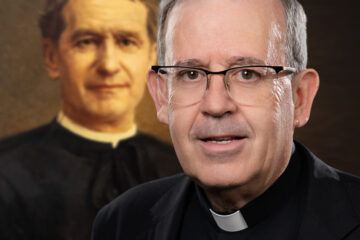
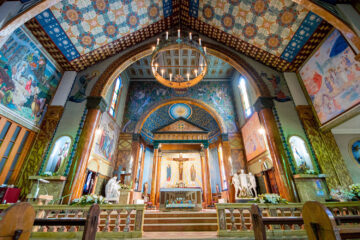
0件のコメント